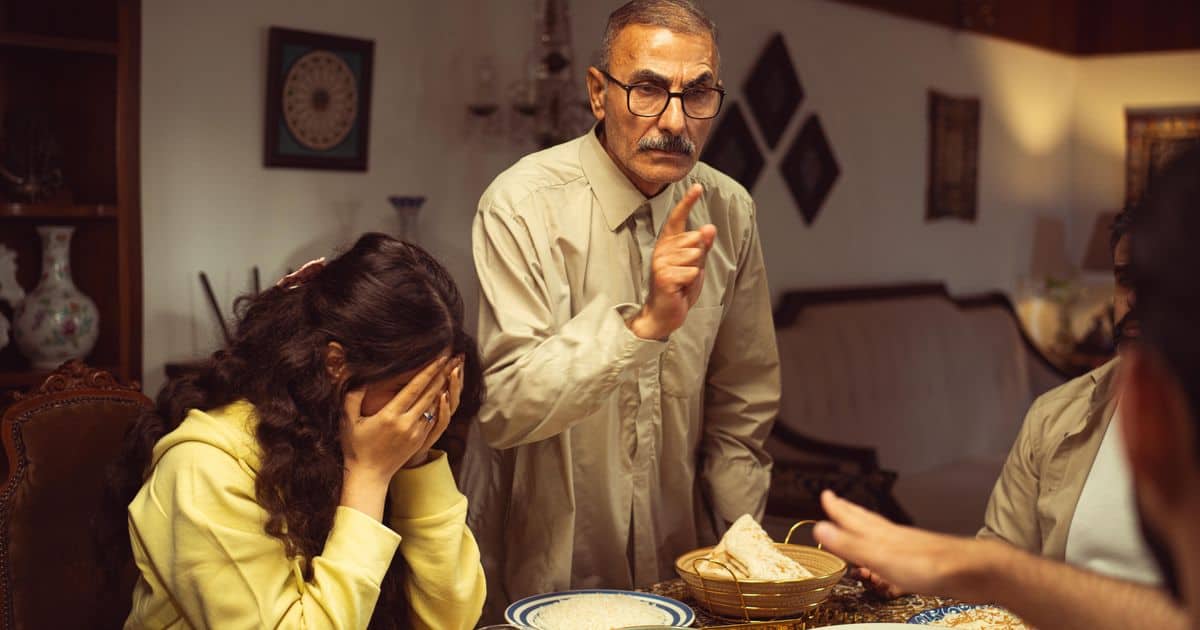
Your last text never turned blue. You tried calling and it went straight to voicemail. You opened Instagram and her profile says user not found. Same on WhatsApp, same on Snapchat. Three days ago you were fighting about something you can barely reconstruct now. Tonight you are sitting on the edge of the bed with your thumb hovering over “create new account,” running the math on whether her sister would answer you, and wondering if you could just drive over and make her listen for five minutes. So at 11pm you typed it into a search bar: she blocked me on everything.
Why did she block me on everything?
Stuck in the same fight again?
Talk it through with Figlet right now. Private, judgment free, built on 17 years of couples therapy.
I have been a couples therapist for seventeen years, and when someone blocks every channel at once, it almost always means one thing first: she ran out of other ways to make the pain stop. It is not automatically proof that she never loved you. It is not automatically a punishment. It is not automatically forever. But it is a clear request, the clearest one she could find: stop contacting me. And the single thing that gives anything good a chance from here, including repair, is that you respect it completely.
Is she punishing me, or is she done?
I have written to the person on the other side of this button, whose thumb hovers over block for ten minutes. What I tell them: blocking is not a statement about the other person. It is a harm reduction strategy for a nervous system. Romantic love runs on the same reward circuitry as cocaine. Every notification with your name on it is a pull of the lever. Her body cannot finish grieving, or even calm down enough to think, while it keeps receiving little doses of the person it is hurting about. Blocking removes the option entirely instead of asking her to resist it forty times a day.
Silence is never empty, though, and in my office a wall like this usually says one of three things.
Sometimes it is protest. “You hurt me and I want you to feel the weight of that.” That kind of block often comes in the heat of a fight.
Sometimes it is shutdown. Her body has gone offline because staying online with you got too painful. On the Compass of Shame, withdrawal is the quietest direction: if I make myself small enough, maybe the pain will not find me. If this is her, she is not cold. Underneath the wall, her nervous system is screaming, and the block is the only thing that turns the volume down.
And sometimes it is the burnt-out pursuer. If she spent months or years being the one who reached, who complained, who asked you to put the phone down, who cried, who wrote the long text, then each time her body was asking, Are you there for me? Each time the answer came back defended, deflected, or absent, another small file got written into her body. He is not coming. I am on my own. Eventually the pursuer collapses. Not because she stopped loving you. Because the biological cost of reaching for someone who does not reach back is unsustainable.
You cannot know from the outside which one it is. But there is a rough read. A person who is still bonded to you is often terrible at ending things: the mixed message at midnight, one foot in your world and one in the exit. That is a frightened person, not a finished one. The clearer sign of a real ending is calm, organized follow-through. She said it once, plainly, and then she closed the doors. Either way, none of it changes what you should do tonight.
Why does this feel like I am dying?
Because to your body, it is close. We are mammals. On the savanna, if your person cast you out, you died. Social exclusion lights up the same regions of the brain as physical pain. In the first weeks after a loss, the attachment system goes into what Bowlby called protest. Every cell is oriented toward reunion. And your prefrontal cortex, the part that plans and weighs consequences, goes partly offline.
Then there is the shame. Being shut out by someone you are bonded to is a shame event in the body. It hands you evidence for whatever sentence you already believed about yourself: nobody stays, I am not enough. Shame burns, so your body runs to one of the four points on the Compass of Shame to get away from the heat.
Watch for two of them tonight. Attack other: she is cruel, she is playing games, she is immature, she owes me a conversation. You start building a case, a Story of Other, and it feels productive because clarity always seems one more piece of evidence away. It never is. Attack self: I ruin everything, why would anyone stay. That one feels like accountability. It is not. It is shame talking.
Should I make a new account, show up, or message her friends?
No. Not one of them.
It feels like fighting for the relationship. I call the one who reaches the Relentless Lover, and the thing the Relentless Lover keeps missing is how the reach lands. Your pursuit lands on her as pressure. It is like throwing a boomerang. You throw the protest because you want out of pain. It guts her. Then it comes back and guts you with even more force.
The new account is the chase wearing different clothes. You are still organized entirely around her. The grand gesture, the letter, the flowers on the doorstep, the speech about how you have changed, is what I call emotional fiat: affection printed by decree with nothing behind it. Her body keeps a ledger of what the relationship felt like, and that ledger does not clear because someone said the right words.
Going around a block is not romantic. Making new accounts to reach her, showing up at her home or her work, sending messages through her friends or family after she has cut contact: from the inside, it feels like drowning. From the outside, it looks like stalking, and it can become harassment, with real consequences for her safety and for you. She has told you what she needs. Respect it. There is a difference between grieving and acting out. Acting out is when the longing drives the behavior. Grieving is when you feel it fully and do nothing about it.
What I learned when my words could not reach her
There was a period where my wife Teale was completely unreachable to me. Not fighting. Not crying. Just gone. A desert. I would apologize, and my apologies were, if I say so myself, beautiful. Articulate. Full of insight about what I had done and why it had hurt her. They did nothing. They landed on the sand and evaporated.
Sitting there with my beautiful apologies dying in the air, I understood that words could not reach what my behavior had built up in her body over years. It was the accumulated ledger of every small no I had logged in her nervous system without knowing I was logging it. The only thing that eventually reached her was not more words. It was my willingness to sit inside her flatness with her. To stop trying to fix it. To let it exist. To not need her to come back on my timeline.
That last sentence is the whole thing. Every workaround you are considering tonight is a way of getting her back on your timeline.
If the block is about fear
Everything here assumes a fight or a breakup between two hurting people. If she blocked you because she is afraid of you, because there was violence, threats, blocking her exit, control of her money or her phone, or you have already been showing up where she did not want you, that is not a dance. Do not try to win her back. Get help for yourself today. If you are the one who is afraid, the National Domestic Violence Hotline is 1-800-799-7233. And if the urge to reach her comes with thoughts of hurting yourself, please call or text 988 now.
What can I actually do tonight?
Probably nothing tonight. 11pm is not when the message that matters gets written.
Tomorrow, in daylight, look at what she left open. Not a back door you can pry: a channel she chose not to close, like an email address she did not block. If there is one, you can send one message. Once. Word for word, something like this:
“I’m not writing to ask you to come back or to explain myself. I can see you needed space, and I’m going to respect it. I can see now that when I felt like I didn’t matter to you, I came at you harder, and that left you feeling like you could never get it right. I’m sorry for what that did to you. I won’t contact you again. If you ever want to talk, I’ll be glad to hear from you, and if you don’t, I understand.”
Then stop. No follow up. No checking whether she read it. That is the part that proves the message was true.
If she closed every channel, the answer is none. No message is the message. It says the one thing your pursuit could never say: I heard you.
Then take care of your body, because it is in withdrawal. When the urge hits, wait 90 seconds, roughly the length of a neurochemical wave. And send one text to your closest friend: “She blocked me and I keep wanting to find a way around it. I need you to not tell me what she’s doing, and to talk me down if I ask.” That sentence said to a friend does more for your nervous system than a hundred sentences said to her.
If you are the one who blocked him
You are not cruel for pressing the button. Blocking is medicine, not spite. If it is safe and you have it in you, one sentence, said once, can spare you both a lot of noise: “I need space to heal. Please don’t contact me for [a specific amount of time].” If he keeps coming around the block, keep a record of what he sends and talk to someone who does this for a living. You do not owe anyone a conversation you are afraid to have.
Where to go from here
If you want to understand the block from her side of the button, read should I block my ex. If the question underneath everything is whether she is frightened or finished, will my ex come back is the honest read, with no list of signs. If you are still hoping for repair, how to get your ex back explains why the campaign fails and what actually gives repair a chance. And if tonight is mostly about surviving the next 48 hours, start with how to cope with a breakup.
If it is late and your thumb is on “create new account,” tell Figlet instead. Figlet is a tool I built on the same work I do in my office. Tell it what happened. It will show you the dance the two of you were in and help you find the one line that owns your step without a word of pressure in it, or help you sit with the fact that tonight the line is silence. It is free to start tonight.
Keep Reading


Stuck in the same fight again?
Figlet is relationship coaching built on 17 years of couples therapy. Talk through what is happening the moment it matters, get a clear next step, and stop circling the same fight. Private, judgment free, ready whenever you are.
Free to start. No credit card needed.
Figs O'Sullivan
Founder · EFT couples therapist
“What I would tell you at 10pm, if I could.”