
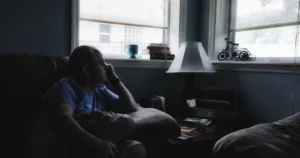
Photo by Alexander Krivitskiy on Unsplash
Photo by Alexander Krivitskiy on Unsplash
You are standing in the kitchen on a Tuesday night and it is happening again. You forgot to text when you landed. Or you made a comment about his mother at the dinner four months ago. Or you looked at your phone during the thing he was telling you about work. And now the whole evening has tilted. He is bringing up the time in 2019. He is bringing up what you said at Christmas. He is bringing up the fight you thought you resolved in therapy last March, the one you cried through, the one you thought was finally behind you.
You typed “my husband won’t let anything go” into your phone because your body is tired. You have apologized. You have explained. You have changed. You have agreed with him, disagreed with him, written letters, done the work, and still, the ledger is open. Every disconnection cracks it back open. Every small rupture becomes a doorway into every old rupture. You feel like you are married to a man with a prosecutor’s memory and no statute of limitations.
Come here to me. I have been a couples therapist for seventeen years, and I need to tell you something before you scroll into the next article that will tell you he is controlling, resentful, or incapable of forgiveness. That framing is almost always wrong. And it will make the thing you are inside worse, not better.
Your husband is not holding onto the past because he enjoys it. His nervous system is holding onto it because something that happened there never got finished. And until you understand what finished actually means in a body, you will keep paying for the same debt over and over and never clear it.
Recognize this exact loop?
Talk to Figlet about the pattern where your husband keeps re-opening old wounds. AI relationship coaching grounded in Figs O’Sullivan’s work, LMFT. Free to start, no credit card.
The Nervous System Keeps Its Own Books
Stuck in the same argument again?
Talk it through with Figlet right now. Private, judgment free, built on 17 years of couples therapy.

Here is what I want you to understand first, because the rest of this will not land otherwise.
The human body keeps a ledger. You did not consent to it. It keeps itself. Every rupture that happened between you and your husband, every moment he reached for you and felt you go flat, every time he brought something up and watched your eyes go cold, every time you corrected him instead of meeting him, every misread, every flinch, every eye roll he caught in his peripheral vision, it was logged. Not in his conscious memory, exactly. In his body. In the specific tightness behind his sternum when you walk into the room now with that particular tone.
Grounded in attachment theory, adult love partners regulate each other the way a caregiver regulates an infant. The bonded body only ever runs two questions, and never in words. Are you there for me. Am I enough for you. Your husband’s body is running those questions right now, under every argument about the dishwasher, every re-litigation of the thing you said three Christmases ago.
When something painful happens between two bonded people, the nervous system needs a very specific thing to close that transaction. It needs the hurt to be met. Not solved. Not argued with. Not explained away. Met. Witnessed. Received by the person who caused it, with their nervous system actually online and present and taking in the fact that it landed.
If that meeting does not happen, the event does not settle. It stays live in the body. To your husband’s nervous system, the thing from four months ago is not a memory. It is an active threat, still happening, still unresolved, waiting for the moment it can be surfaced again in the hope that this time it will finally get the response it needed the first time.
That is the whole mechanism. He is not punishing you. He is a man whose body is still waiting for an unfinished moment to finish.
Why “I Already Apologized” Does Not Work
I will tell you a story about my own marriage, because I have been on the other side of this exact dynamic and it took me years to figure out.
Early in my relationship with my wife, Teale, before we were officially exclusive, something happened. A relational injury. I will not go into the details. What matters is this: for years into our marriage, that thing kept coming back. Any time we hit a moment of disconnection, Teale would bring it up. The old one. The thing from before we were even officially a couple.
And here is what I did, for years. I fought the facts. We were not even exclusive then. I did not technically do anything wrong. I would marshal my evidence. I would make my case. I would prove, with the clean clarity of a man who had the receipts, that I had not actually violated any agreement that existed between us at the time.
Every time I did this, the splinter went deeper. Every time I defended my innocence, her nervous system got the same message: your pain is invalid. Your hurt does not count. You are wrong to still feel this. I was fighting the facts, and she was fighting for her feelings. We were in completely different courtrooms with completely different cases.
The thing only started to settle the day I stopped defending my case. The day I said something close to: it makes sense that you hurt. Even if I did not break a rule, I broke your heart. And I am sorry.
That is it. That is the whole shift. Nothing about the facts changed. What changed was that her nervous system finally got the one thing it had been waiting for. A witness.
I write more about this exact pattern in Can You Change Your Attachment Style, because this kind of shift is not an idea you grasp. It is an embodied experience that reorganizes the body over time.
The Loop You Are Caught In
What you are describing has a shape. I call the pattern underneath it the Waltz of Pain, and it has a very specific 1-2-3 choreography that both of you are doing without knowing it.
Step one. He feels a crack in the bond. You check your phone. You snap about dinner. You forget a thing. His body goes into alarm, and his judgment of you flashes: she does not care, she never cared, she is just like she was that other time.
Step two. A secondary emotion rises in him. Anger. Frustration. The sharp heat of resentment. Underneath it, something softer and much more painful. But he does not touch the softer thing. He touches the anger, because anger has a direction and softness does not.
If you want to understand that sharp heat from the inside, I explain what it means to resent someone and why it outlasts the original hurt.
Step three. He brings up the past. The old fight. The old wound. The ledger entry from eighteen months ago that he is sure proves something about who you really are.
And then you do your part of the dance. You judge him: he will never let anything go, he is impossible to please, nothing I do is ever enough. You feel your own secondary wave of resentment rising. And you defend, explain, withdraw, roll your eyes, go flat, or walk out of the room.
Here is the piece almost nobody sees. His bringing up of the past is not aggression. It is protest. It is the sound a nervous system makes when it is desperately trying to get the thing it needed and never got. And your eye roll, your flat face, your “we have talked about this a hundred times” is heard by his body as the same message he heard the first time: you do not matter enough for me to actually meet you here.
Which is why he brings it up again next week. Louder. And the loop tightens.
What His Protest Is Actually Saying
Underneath the surface complaint, his body is almost always saying one of two things, depending on which attachment position he lives in.
If your husband is what I would call a Relentless Lover, the one who reaches and protests and pursues, his vulnerable truth under the re-litigation is: when you turn away or dismiss my pain, I feel sad, I feel abandoned, I feel terrified that I do not actually matter to you. The old wound is a doorway he keeps walking through because he does not know how else to tell you that he needs you to see him right now.
If he is a Reluctant Lover, the one who withdraws and goes cold and offers chilly logic, the holding on looks different. It is less active re-litigation and more an atmosphere of unforgiveness. A long silence around the thing. A sense that the wound is still in the room even when nobody has named it. His vulnerable truth there is: I feel a crushing sense that I am failing you, that I am not enough, that I will never be able to protect myself from the next time you prove I was never enough.
Either way, the content of the complaint is almost never the point. The nervous system wants what nervous systems always want. Co-regulation. Proof that the person on the other side of the bond is actually there, actually present, actually taking in the fact that something they did caused real pain in the person they love.
If you want to name where you are in all this before you bring any of it into conversation, you can take the free Figs Quiz.
Ready to work on this?
Figlet is AI relationship coaching grounded in attachment science and Figs O’Sullivan’s clinical work, LMFT. First messages free, no signup.
Why Your Apology Did Not Settle It
Here is the hard part. You probably have apologized. Probably more than once. And it did not land.
I want to tell you why, because this is the single most common place I see couples get stuck.
Most apologies are performed from the shoulders up. They are intellectual acknowledgments. They are case-closed statements. They have the shape of an apology but not the substance. “I am sorry. I was wrong. Can we move on now.”
The last three words are the giveaway. If an apology comes with a request to be let out of the room, your husband’s nervous system can smell it. The apology is not a meeting. It is an exit strategy. His body knows it. Which is why ten minutes later, or ten days later, the ledger is open again.
A real apology, the kind that actually settles something in the body, requires you to stay. To stay inside the discomfort of being the person who caused this. To let his pain actually land in you. To feel it. To not defend. Not even once. To not say “but” or “I was also” or “if you had just”. To receive the hurt the way you would receive a child’s hurt, with your whole body, no agenda to be released.
When his nervous system feels you actually there, actually taking it in, actually not trying to escape, something shifts. The thing moves from the active threat drawer in his body to the historical record drawer. The event stops happening and starts being a thing that once happened.
That is the only mechanism I have ever seen for genuine letting go. It is not forgiveness as a decision. It is the body, finally met, closing a loop it has been trying to close for months or years.
The Thing You Are Longing For
Let me name what I think is actually happening in you, because none of this will work if you are reading it as a list of chores to perform for him.
You are tired. Something in you is braced for the next time. You have started to feel like you cannot win, which means you have started to feel like you are living under a prosecutor instead of beside a husband. Part of you is wondering if he is incapable of change. Part of you is wondering if you should leave. Part of you has started to go cold inside the house just to survive the atmosphere.
I want you to hear me. That exhaustion is real. And it is also likely a sign that your nervous system has been doing the only thing it knows how to do when the bond feels unsafe, which is to go flat and conserve. That flatness, which to you feels like self-protection, is what his body is reading as proof that you do not care. And his protest is what your body is reading as proof that you can never be enough. Both bodies are confirming each other’s worst fear in a feedback loop that neither of you is choosing.
The way out is not for one of you to be the bigger person. The way out is for the loop to be named out loud, by both of you, as the thing you are both trapped in. You are not opponents. You are two people with scared nervous systems doing a dance that is hurting you both.
If this pattern feels familiar from your own side, Intimacy Avoidance: What’s Actually Happening When You Pull Away From the Person You Love goes deep into what happens inside the partner who starts to go flat under relentless hurt.
What To Actually Do, Tonight
I am not going to give you a script. I will give you a shift.
The next time he brings up the thing from four months ago, do not defend. Do not explain. Do not say we have been over this. Do not sigh. Do not fix your face.
Instead, slow down. Take a breath into your belly. Try to feel his pain in your body for ten seconds without needing to do anything about it. And then say something close to: it makes sense you still hurt about this. I did not meet you properly when it happened. I want to meet you now.
Then stay. Do not reach for the exit. Do not ask when we can move on. Let him have whatever response he has. Tears. More anger. Suspicion that you are patronizing him. Whatever comes. Stay with your body present and your face soft and your attention actually on him.
This is not a one-time fix. The ledger has a lot of entries on it. But if you can start to do this, even imperfectly, something will begin to change in the room. His body will begin to register that this time is different. That you are actually here. And the ledger will begin, slowly, to settle itself.
What you are learning to build, over time, is what I would call secure attachment between you. Not the absence of conflict. The presence of a bond that can metabolize hurt instead of accumulating it.
Common Questions
Why does my husband keep bringing up the same fight over and over?
Because his nervous system has filed the original rupture as unfinished. To his body, it is not a memory of a past event. It is a live, open loop still waiting for the response it never got. He will keep bringing it up until that moment is actually met with presence and emotional witnessing, not with your explanation of why he should be over it by now.
Is it emotionally abusive if my husband won’t let anything go?
In most cases, no. It is a protest from a hurting nervous system that has not been met. True emotional abuse looks different: control over your money, your movement, your access to people, consistent gaslighting of your reality. Litigating old wounds is painful and exhausting, but it is almost always an attachment protest, not abuse. The two require very different responses.
How do I apologize so my husband will actually let it go?
Apologize with your body online, not from the shoulders up. Do not include any version of “can we move on now.” Do not defend the facts. Say that it makes sense he hurts, that you broke his heart even if you did not intend to, and then stay in the room with his response. The apology that settles something is the one that does not try to escape.
Could this mean my husband has an anxious or disorganized attachment style?
Possibly. Persistent re-litigation of old wounds is often what the pursuing or anxious partner does when their core question, are you there for me, keeps going unanswered. If there is also a history of unpredictable or frightening early caregiving, the pattern can carry a disorganized flavor, where closeness itself feels unsafe. But labeling him matters less than seeing the loop you are both in.
What if I have already apologized a hundred times and he still brings it up?
Then the apologies have not been the kind his body needed. Quantity does not matter. Quality of presence does. One real moment of staying inside his hurt, letting it land, not defending, not escaping, will do more than a hundred intellectual sorries. If you cannot find that place in yourself, that is useful information too. It means something in you is also not being met, and the loop needs both sides.
Do not just close the tab on this.
Bring what surfaced here into a real conversation. Figlet coaches you through the exact pattern where your husband cannot let the past go, grounded in Figs O’Sullivan’s work, LMFT. Free to start.
The ledger does not clear itself. It clears when one body finally meets another. That is the work. Start there.
Keep Reading


Stuck in the same argument again?
Figlet is relationship coaching built on 17 years of couples therapy. Talk through what is happening the moment it matters, get a clear next step, and stop circling the same fight. Private, judgment free, ready whenever you are.
Free to start. No credit card needed.
Figs O'Sullivan
Founder · EFT couples therapist
“What I would tell you at 10pm, if I could.”





