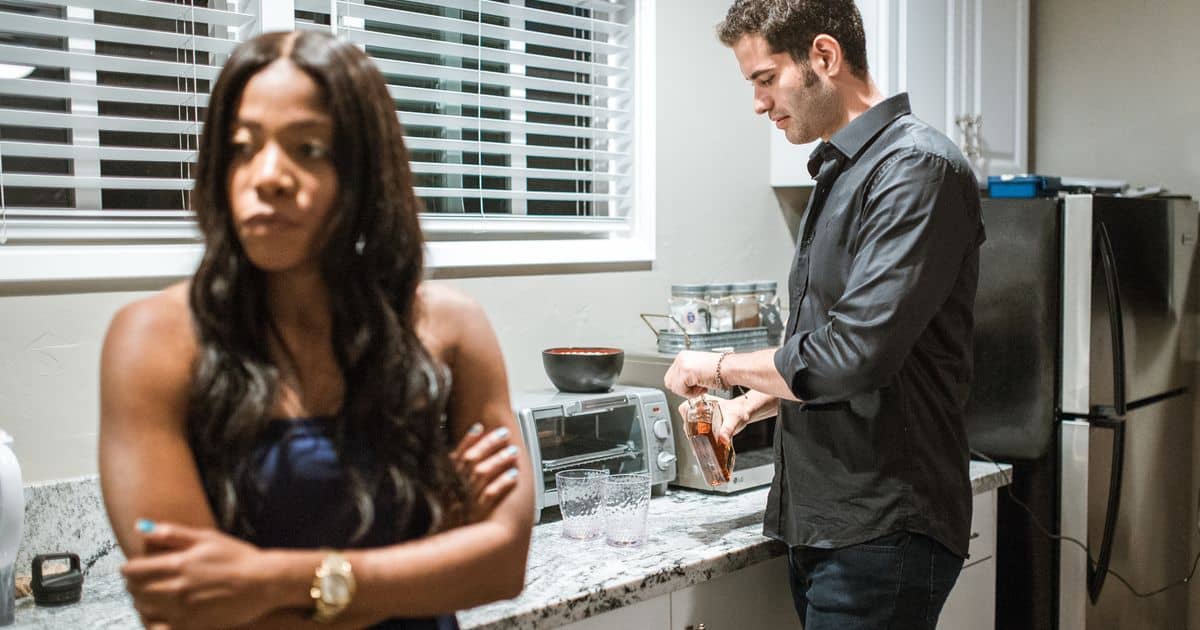
Photo by Vitaly Gariev on Unsplash
Photo by Vitaly Gariev on Unsplash
You are standing in a kitchen full of people. Someone laughs at a story your husband is telling, and then his voice shifts, just a quarter turn, and the next sentence out of his mouth is about you. How you can never remember the dates. How you got lost coming back from the bathroom. How you spent too much on the thing. The room laughs with him, or worse, the room goes quiet.
Something in your chest clamps down. Your face goes hot in that specific way that tells you the heat is visible. Your stomach drops into a cold hollow spot. The conversation keeps moving. You keep smiling. You take a long sip of your drink and you make your eyes do the thing where they look fine. Inside your body, something ancient is screaming.
You typed “my husband belittles me in front of others” into your phone later that night, after everyone had gone home, after he had fallen asleep next to you like nothing had happened. You wanted the internet to tell you what to do. The internet handed you three fast answers: he is a narcissist, this is emotional abuse, leave or go grey rock. I understand the pull of those answers. When your body has just been publicly cut, a diagnosis feels like a floor to stand on.
I have been a licensed marriage and family therapist for seventeen years. Before you accept any of those answers, I want to slow you down and show you what I actually see when a couple in this exact pattern sits on my couch. Because the frame the internet gave you will not help you. In many cases it will make the pattern worse.
The Public Multiplier
Resentment quietly building between you?
Talk it through with Figlet right now. Private, judgment free, built on 17 years of couples therapy.

Here is the thing almost nobody names in articles on this topic. When criticism arrives in private, it hurts. When it arrives in public, it hurts about ten times more. The nervous system reads a public put-down from your primary attachment figure as something closer to banishment than feedback. In the biology of belonging, your husband is the one person designated to say, with his whole body, “she is mine, she is enough, I have her back.” A public cut from him says the opposite in a language older than words. Not just “you failed.” “You failed, and the village now knows.”
If the cuts come in private too, I wrote a separate piece for the wife who says my husband makes me feel like everything I do is wrong.
That is why you cannot shake it off the way friends suggest. That is why “he was just joking” does not land in your body as true. Your organism knows the difference between teasing from inside a secure bond and a sharp line thrown across a room with real voltage behind it. The ten-times multiplier is not drama. It is biology. Attachment theory has shown for decades that adult partners regulate each other the way caregivers regulate infants. When the regulator becomes the threat, in public, the body goes into a kind of free fall.
Recognize yourself in this?
Talk to Figlet about it right now. AI relationship coaching grounded in Figs O’Sullivan’s work, LMFT. Free to start, no credit card.
What His Behavior Actually Is: Attack Other
In my clinical work I use Donald Nathanson’s Compass of Shame to map what is happening inside the person doing the belittling. The compass has four points: withdraw, attack self, avoid, and attack other. Public put-downs sit squarely in attack other.
Here is the counterintuitive part. People who deploy attack other are not operating from calm superiority. They are running from their own unbearable internal collapse. Shame, the hot whisper of “I am not enough, I am going to be found out,” is one of the most unmetabolizable feelings in the human organism. When it rises, the body reaches for whatever strategy will discharge it fastest. Attack other discharges it by relocating the inadequacy. If I can make you the one who is small, awkward, forgetful, too much, then for a few seconds I am not.
Public settings make the internal shame worse, not better, for the person doing it. The audience raises the stakes on his own felt adequacy too. If he is quietly carrying a sense that he is failing at work, failing as a provider, failing as a man in some private theater of his own head, a room full of other men and their wives will amplify that feeling. Rather than risk being exposed as the one who is not enough, his nervous system preemptively nominates you. He belittles you first to control the frame.
This is not an excuse. His behavior is still corrosive, still painful, still doing damage. But if you treat him as a cold strategist, you will swing at a target that is not there, and the real driver will keep running underneath. The real driver is a protector part doing a job it learned to do a long time before he met you.
What You Are Really Longing For
I want to turn the lens now, because the search query is yours, not his. What is your nervous system actually asking for in the moments after a public belittling? Most readers tell themselves they just want an apology. That is downstream. Underneath the apology, there is a two-part longing.
First, you want him to notice. Not that you were upset. That he hurt you. To spontaneously see what landed on your face and move toward it, without you having to assemble the evidence and present it like a legal case.
Second, you want him to repair. Publicly, if it happened publicly. A hand on your lower back in the moment. A line in front of the same people that gently takes it back. Later, in the car, a real look in your eyes.
The second longing is bigger than the first. Repair is what actually heals the attachment rupture. Without repair, the public cut goes into what I call the somatic ledger, the running record your body keeps, incorruptible, of every time reaching for him or being near him cost you something. The ledger is why you flinch at the next dinner party before anything has even happened. It is not paranoia. It is accurate memory stored below language.
The Pattern Underneath: The Waltz of Pain
In my framework, conflict is never a collection of random bad behaviors. It is a structured, circular dance I call the Waltz of Pain. Three steps, over and over.
Step one: a negative perception of the other. He perceives something about you, usually something that touches his own tender spot. Maybe you corrected him in front of his friend. Maybe you looked at your phone while he was telling a story. Maybe nothing you did at all, just an old shame that got stirred by the room.
Step two: a secondary, reactive emotion. Not the raw hurt or fear underneath. The righteous, mobilized version. Irritation. Contempt. A knowing little smirk.
Step three: a protective action. In his case, the sharp line about you across the room.
Then your three steps fire. You perceive him as cruel, callous, or hateful. You feel the shame of being exposed and the terror of being alone inside your marriage. Your protective action is some combination of going silent for the rest of the night, crying in the car, bringing it up at 1 a.m. with a precision that will not land, or quietly starting the long interior process of leaving.
His next step one is your silence or your late-night confrontation, which lands on him as proof that you are impossible to please, cold, nagging, humorless. His step two fires again. His step three gets sharper. Round and round.
The dance explains why the usual interventions do not work. Asking him to stop will not stop him, because he is not choosing from the top of his thinking brain. Leaving the room after it happens trains the cycle to continue. Explaining the hurt with better words meets the same protector that fired the first shot. The dance has to be seen as a whole, by both of you, from a vantage point outside the music.
If you want to name your own position in this dance before anything else, you can take the free Figs Quiz and get the clinical frame in about five minutes.
The Representative in the Room
There is one more layer I want to give you, because it will change how you see him. High-functioning adults, especially men who achieved by being sharp, articulate, and quick, develop a part of themselves I call the Representative. The Representative is the polished, strategic version he sends into every room. The Representative knows how to win. The Representative learned, probably in his family of origin, that getting the first cut in meant you did not get cut yourself.
When attachment feels shaky, the Representative drops the diplomacy and brings the heavy weaponry. Sarcasm. Public put-downs. The joke that is not quite a joke. He may even feel a quiet, defended pride in that ability. “No one pulls a fast one on me.” The problem is that the Representative does not know how to be loved. The Representative only knows how to be respected, feared, and admired. And you did not marry the Representative. You married the person underneath, the one who sometimes, in the dark, reaches for you and says the one true sentence of the week.
Protecting is not the same as connecting. The strategies that kept him safe as a boy are precisely the strategies destroying his marriage now. He probably cannot see this yet. You can.
Why “Just Set a Boundary” Is Not Enough
The internet will tell you to set a hard boundary. “If you belittle me in public again, I will leave the room.” I understand the appeal. In some cases, especially where there is real emotional abuse, a line like that is necessary and correct.
But in most of the couples I sit with, the hard boundary delivered without the deeper frame does one of two things. Either he complies at the surface, stops the obvious put-downs, and the contempt leaks out sideways in a hundred smaller ways. Or he escalates, reads the boundary as another verdict against him, and the protector part doubles down. The behavior stops being public and starts being colder, or the marriage quietly dies in a different register.
The move that actually shifts the pattern is more demanding than a boundary. It is naming the dance, out loud, with him, when neither of you is activated. Not in the car after the dinner. Not at 1 a.m. On a Saturday morning, with coffee, when the house is quiet.
The sentence sounds something like this: “I want to talk about what happened at Pete’s house. I am not interested in making you the bad guy. I think something is happening between us that neither of us wants, and I am scared of where it is going. When you said that thing about me in front of them, I felt like you had taken a side against me in public. I went cold for the rest of the night. I know you felt that too. I want to understand what was happening in you right before that line came out, because I do not think you woke up that morning planning to hurt me.”
That sentence does three things at once. It names the injury without diagnosing him. It invites him to look underneath his own behavior rather than defending it. And it signals that you are willing to see him as a whole person, not just as the attacker. If his protector part is going to drop its weapons for even a moment, it needs that invitation. If he refuses the invitation repeatedly, that is also real information, and it points toward different decisions.
Ready to work on this?
Figlet is AI relationship coaching grounded in attachment science and Figs O’Sullivan’s clinical work, LMFT. First messages free, no signup.
Earning a Different Bond
Secure attachment is not something either of you was handed in a tidy package in childhood. For most couples, it is something you build, with real work, inside the relationship you are already in. I have written more about that path in this piece on secure attachment and what it actually looks like and about whether these early patterns can genuinely shift in this one on changing your attachment style.
The short version: patterns like this one do shift, but not through willpower, and not through you reading more articles while he reads none. They shift when both nervous systems get the repeated experience of staying present through a hard moment and coming out the other side still connected. When he drops the Representative and shows you the boy underneath who was humiliated at ten by his own father, and you stay. When you tell him the public cut made you feel like a stranger in your own marriage, and he does not defend, does not minimize, does not pivot to what you did wrong.
Those moments are not accidents. They are built. Usually with help. Sometimes the help is a good therapist. Sometimes it is a coaching tool. Sometimes it is a long weekend away from kids and screens where the two of you finally stop performing for each other. The point is that waiting for it to resolve on its own almost never works. The dance is self-reinforcing. Something has to interrupt it from outside the music.
The Thing to Hold
I want you to hold two things at once, which is one of the hardest asks in all of adult relationship work. First, what he is doing is not acceptable. It is hurting you. It is corroding the bond. You are not making it up, overreacting, or too sensitive. Second, he is almost certainly not doing it from a place of calm cruelty. He is doing it from a protector part that learned to attack before it got attacked, and that part is terrified of what will happen if it ever lays down its weapons.
Holding both is not weakness. It is the only vantage point from which the pattern can actually change. If you collapse into “he is a monster,” the dance continues with new choreography. If you collapse into “he does not mean it, I should be more patient,” the dance continues with you taking more damage. The vantage point in the middle, where you can see the whole dance and refuse to keep dancing it, is the one real exit.
Common Questions
Is my husband belittling me in public a form of emotional abuse?
Sometimes, yes. The clinical distinction is pattern, intent over time, and willingness to repair. A one-off cut followed by genuine recognition and change is a rupture. A chronic pattern of public put-downs, denial that it is happening, and no willingness to look underneath it crosses into emotional abuse. If you have asked him to stop, named the hurt clearly, and the behavior continues or escalates, you are no longer in a repair conversation. You are in a safety one.
Why does he only belittle me in front of other people and not when we are alone?
Because the audience is the point. Public settings activate his own felt inadequacy at ten times the volume of a private room. Attacking you in front of others discharges his rising shame by relocating the inadequacy onto you, and it does so quickly, with social cover. In private he does not need the maneuver, so you see the warmer version of him and start to doubt what you felt in public. You were not wrong. Public is where the strategy fires.
Should I confront him in the moment or wait until later?
Wait. In the moment, both of your nervous systems are flooded, and nothing useful can be said. Confronting in public will trigger his protector part even harder and give him new material. Confronting in the car ride home is almost always a disaster. Wait until the next morning or later, when both of you are regulated, and open with the pattern, not the incident. The regulated conversation is the one that can actually change something.
What if he refuses to go to couples therapy or admit anything is wrong?
Common, and worth understanding rather than taking personally. For many men, agreeing to therapy reads internally as agreeing he is the broken one. The invitation that lands best is framed as curiosity about the pattern between you, not as a verdict on him. If he still refuses, you can do real work on your own side of the dance, and your changes will put pressure on the system. One partner shifting is often enough to force the other to meet it.
How do I know whether to stay or leave?
I will not answer that for you, and anyone who answers it fast is not helping you. The clinical question I would hold is this: when you name the pattern clearly and invite him underneath it, does he come, even clumsily, or does he refuse, deny, and double down? Repeated willingness to look, even imperfect willingness, is the raw material of a different marriage. Repeated refusal, over months and years, is also an answer.
Do not just close the tab on this.
Bring what surfaced here into a real conversation. Figlet coaches you through it, grounded in Figs O’Sullivan’s work, LMFT. Free to start.
You already know what you felt in that kitchen. The question is whether you are willing to stop dancing the dance and name it out loud, to him, on a Saturday morning, when the room is quiet. That is where the real work starts.
Keep Reading



Resentment quietly building between you?
Figlet is relationship coaching built on 17 years of couples therapy. Talk through what is happening the moment it matters, get a clear next step, and stop circling the same fight. Private, judgment free, ready whenever you are.
Free to start. No credit card needed.
Figs O'Sullivan
Founder · EFT couples therapist
“What I would tell you at 10pm, if I could.”