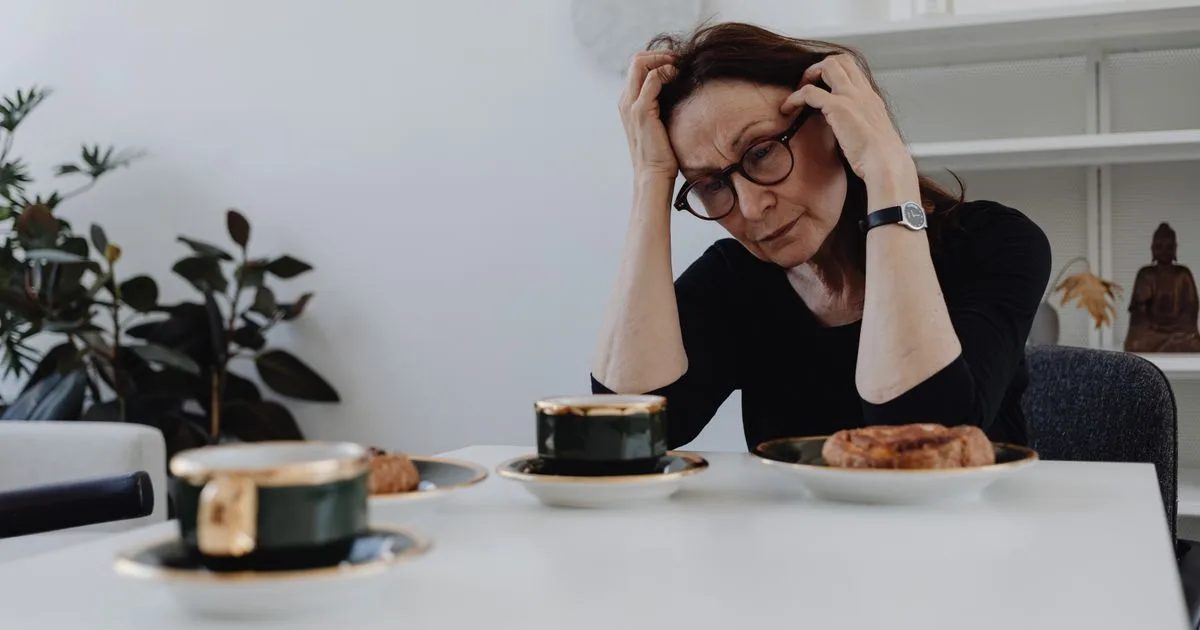
When your husband tells you to calm down, he is almost always telling you something about his own body, not giving you useful advice about yours. “Calm down” never calms anyone, because a nervous system in alarm cannot be ordered back to quiet; what you hear instead is that your feelings are the problem. So you get louder to be heard, he pulls further away, and the fight stops being about whatever started it. If you want somewhere private to put tonight first, tell Figlet exactly what happened when he said it and how it landed, before you say another word to him.
It is late. You told him the thing that hurt. Maybe your voice rose, maybe it cracked. He put his palms up and said it. “Calm down.” Or “relax.” Or “why are you getting so worked up?” Now he is in the other room, and you are typing this into your phone, wondering whether you really are too much.
Why does my husband tell me to calm down?
When talking turns into the same fight
Talk it through with Figlet right now. Private, judgment free, built on 17 years of couples therapy.
I have spent seventeen years across from couples doing exactly this, and the man saying “calm down” is rarely as calm as he sounds. When you bring him a hurt with intensity, his body does not process a request for connection. It processes a verdict. The internal translation, which withdrawing partners describe in my office again and again once the armor cracks, sounds roughly like this: I have failed you before. I am failing you right now. I will keep failing you forever.
For a man who is shame sensitive, that verdict is unsurvivable. Shame is a body event, and the body has four exits. Donald Nathanson called them the Compass of Shame: withdraw, avoid, attack self, attack other. “Calm down” avoids your feeling and quietly hands the failure back across the table: the problem is not what I did, it is how much you feel about it.
He may also be flooded. Your amygdala, the alarm system, fires six seconds before your prefrontal cortex even knows something happened. His does too. When your intensity crosses the edge of his window of tolerance, he drops toward shutdown, and “calm down” is the sound of a man who needs the intensity to stop because he cannot stay inside it. What I usually find underneath is: “I can’t stand being the reason you’re upset, so I need it to be smaller.”
Where the reflex often starts
I had a client (details changed for privacy) who grew up with a mother who treated every emotion as an emergency. If the client was sad, the mother would spiral into panic. If the client was angry, the mother would cry. The client learned very early that having feelings was dangerous, not because the feelings were wrong, but because expressing them created chaos. By the time this person landed in my office at forty-two, they had built a fortress. Their partner described them as “emotionally unreachable.” Those were walls built by an eight-year-old who learned that emotional expression was a threat to the people they loved. The work was not to tear the wall down. It was to install a drawbridge.
Many men who say “calm down” are standing behind a wall like that. Your feeling is not dangerous. To a body trained that way, it registers as dangerous anyway.
Why does “calm down” make me so much angrier?
Because to a nervous system in survival mode, “calm down” translates to: your feelings are wrong, your experience is invalid, I am not going to meet you where you are. It is a dismissal dressed up as advice. And dismissal is the exact attachment threat that set off your alarm in the first place.
Underneath every fight, the bonded body runs only two questions, and never in words. Are you there for me? Am I enough for you? You are probably feeling the first one louder. When you are hurting and he answers with “calm down,” your body hears the answer to that question, and the answer is no. In 58,221 completed Empathi relationship assessments, 33% named “alone” as their deepest feeling when love is not working. That is the feeling “calm down” produces: alone in here, with a man three feet away.
None of what is happening in him changes what happens to you. Impact is bigger than intention. He can mean “I want this to stop hurting” and you still receive “you are the problem.”
When a man tells a woman to calm down
The women who type this question have often spent years turning themselves down already. Too sensitive. Too emotional. Too much. When a man tells a woman to calm down, he is not just answering tonight’s feeling. He is landing on every older moment that felt the same, and her body counts them all.
My husband says I am overreacting. Am I?
Sometimes partly, and it is worth an honest look. Silvan Tomkins showed that shame begins as a tiny interruption. Nathanson showed what happens next: your nervous system runs back through every past moment that felt the same. Today’s moment carries two units of pain, but you have two hundred stored from before, and suddenly you feel four hundred. If you can feel that much of tonight is old, those units are yours to tend. The comment that started it is still his.
It is something else when it is a pattern rather than a moment: “calm down” every time you name a hurt, whatever the hurt is, used to end every conversation instead of start one, and never followed by repair. I wrote more about that wider pattern in what to do when your partner dismisses your feelings.
Why do we keep ending up in the same fight?
You feel hurt and bring it to him, often with intensity because this is not the first time. His body perceives threat. He says calm down, or goes flat, or leaves the room. You feel more alone, so you push harder. He retreats further. I call this the Waltz of Pain. You are the Relentless Lover, reaching. He is the Reluctant Lover, backing away from the feeling that he is failing you. Your protest gets called “overreacting.” His withdrawal gets called “cold.” Both labels miss what is underneath. The enemy is the loop, the third thing in the room, and it is chewing you both up.
What not to do when he tells you to calm down
Do not try to prove you are calm. I call content the Chinese Finger Trap of relationships: the harder you pull on it, the tighter it gets. Do not get louder to break through either; to him, the sharper edge confirms the verdict. And do not swallow it for years to keep the peace. What you resist persists. It leaks out sideways as a clipped tone, a two day silence you told yourself was giving space, a breakdown over something small. If being dismissed by the person you love stops hurting, something in you has gone numb, and numb is not healed.
What actually helps
Two nervous systems need to come down, not one. The move that works is a pause that is a promise to return. A shutdown is open ended and unexplained. A repair break has a door back in: “I’m too flooded to be useful right now. I’m not leaving.” Give both bodies about twenty minutes. Feet on the ground, one slow exhale. Then come back, not with the argument, but with the ache underneath it.
When you come back, speak from your Experience of Self rather than the Story of Other. The Story of Other is the case: he is dismissive, he is controlling, he always does this. The Experience of Self is what happened in your body: my chest went hot, I felt alone, I got scared I did not matter. The case gives his defenses something to push against. The experience leaves no verdict to defend. Figlet can help you find those words before you walk back in.
What to say when your husband tells you to calm down
In the moment, say this, word for word: “I notice I’m about to get sharp with you. Underneath that, I’m scared I don’t matter to you right now.”
Later, when you are both back on the ground, say this: “I notice that when I bring something up, you tell me to calm down. I don’t think you’re doing it to hurt me. But it makes me feel like I can’t bring my real feelings to you, and that scares me.”
Then watch what happens after. Softening, even days later, means a loop that can change.
My boyfriend tells me to calm down
The question is the same whether it is your boyfriend, your husband or a partner you have lived with for a decade. The same lines work, and the same test applies: does he come back and repair, or does the topic simply disappear?
When “calm down” is not a dance
If he humiliates you, threatens you, blocks the exits, controls your money or your phone, or you are afraid of him, that is not a dance and you do not need to be calmer. Get help today: the National Domestic Violence Hotline is 1-800-799-7233, or text START to 88788. If you feel hopeless most days, call or text 988.
If you are the husband who said it
Slow down enough to feel what happened in your chest the instant before you said “calm down.” It is usually cold, tight or empty. That is shame, and the sentence was its exit. Name it to yourself: “I am going into shame right now.” Then, instead of “calm down,” try this: “I can see this has hit something deep, and I am not going anywhere.” If you are too flooded to stay, say so, name when you will return, and return. Your work is to stay in the room with her, in your own body, even while the alarm is going off. If you are the one who tends to escalate, I wrote about the other side of this in how to deal with a partner who overreacts.
Where to go from here
If “calm down” is one piece of a wider pattern of being brushed off, read how to deal with a partner who invalidates your feelings, which walks through the full set of moves I teach couples.
Frequently asked questions
Why does my husband always tell me to calm down?
When it happens every time, his body is usually reading your feeling as a verdict that he is failing you, and “calm down” is the fastest way to make the feeling smaller so he does not have to sit inside that shame. It explains the habit. It does not make it okay.
What does it mean when a man tells a woman to calm down?
Most often it means he is flooded and wants the intensity to stop. It lands on her as “your feelings are the problem,” and on top of every earlier time she was told she was too much. If it travels with control, fear or threats, treat it as a safety issue, not a communication issue.
My husband told me to calm down. Should I be upset?
Your hurt makes sense. Impact is bigger than intention, and the phrase dismisses what you feel even when he means well. Let both bodies settle, then tell him what happened in you, not what is wrong with him.
And if you want help with the specific fight you just had, I built a coaching tool called Figlet. You tell it what happened when he told you to calm down and how it landed, it shows you the pattern the two of you got caught in, and it gives you one line to say when you walk back into that room. It’s free to start tonight.
Keep Reading


When talking turns into the same fight
Figlet is relationship coaching built on 17 years of couples therapy. Talk through what is happening the moment it matters, get a clear next step, and stop circling the same fight. Private, judgment free, ready whenever you are.
Free to start. No credit card needed.
Figs O'Sullivan
Founder · EFT couples therapist
“What I would tell you at 10pm, if I could.”