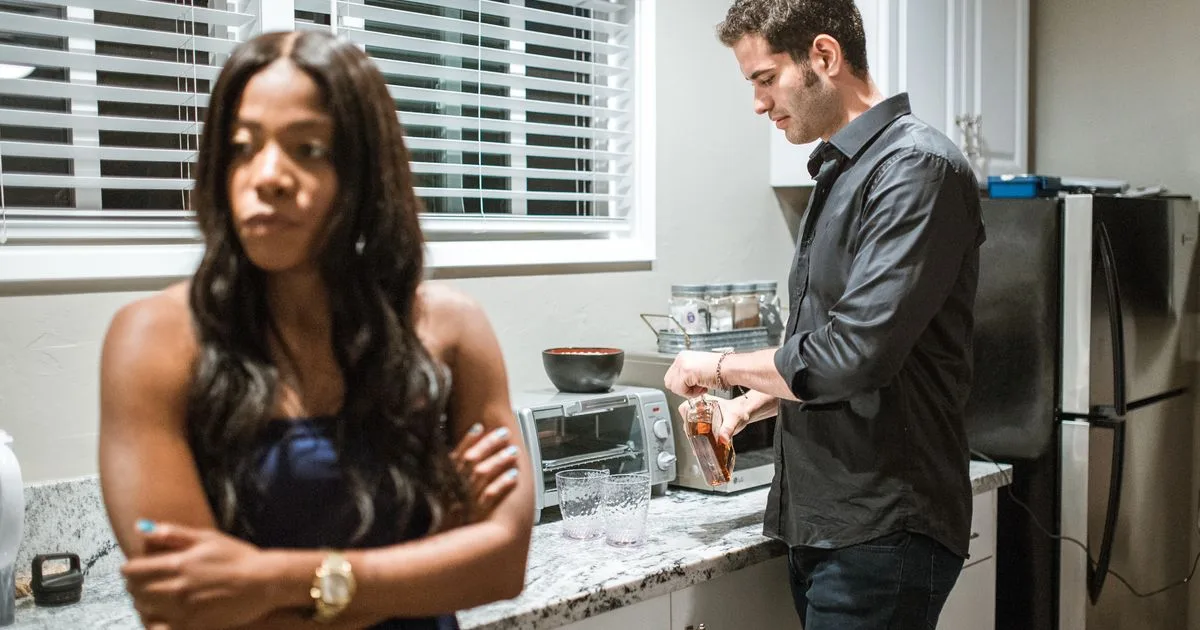
When your husband gets mad when you ask for help, it is usually not about the help. His body hears your request as a verdict, “you have failed me again,” and the anger is a shame reaction: a fast way out of feeling not enough. Sometimes it is stress or a long unspoken resentment about who carries what. It becomes serious when the anger is meant to make you stop asking at all.
You asked him to take the bins out. Or to watch the kids for twenty minutes so you could shower. And his jaw set, his voice went flat, and you got a lecture about how you never notice everything he already does. Now you are standing in the kitchen wondering if asking for anything has become a mistake. I have been a couples therapist for seventeen years, and I see this every week. Before you ask again, tell Figlet what you asked for and exactly how he reacted, and it will show you the pattern running between you.
Why does my husband get mad when I ask for help?
Stuck in the same fight again?
Talk it through with Figlet right now. Private, judgment free, built on 17 years of couples therapy.
A bonded body only ever asks two questions, and it never asks them out loud. Are you there for me? Am I enough for you? When you ask for help, you are asking the first one. You need him. But his body often answers a different question, the second one, and the answer it is already convinced of is no.
You are saying: I need something from you. His body hears: I am about to be told, in detail, all the ways I am not enough. That is why the wall goes up before you have finished the sentence. His nervous system does not process a request. It processes a verdict.
Anger at a simple ask is usually one of four things wearing the same face.
Shame pointing outward. Shame research describes a Compass of Shame with four directions: attack other, attack self, withdrawal and avoidance. Getting mad is attack other. For a second, making you the problem hurts less than feeling he has fallen short again.
A flooded nervous system. If you ask while he is already stressed, mid task or just through the door, there is no room left. Stress shrinks how much a person can hold before the alarm fires, and the snap is the sound of a man who has run out of space, not out of love.
An unspoken ledger. Sometimes the anger is about the split itself. If you carry most of the house, your requests pile up, and if he feels he is already doing a lot that nobody sees, he keeps his own quiet case file. Each new ask lands on a ledger neither of you has opened. I go through the chores side of this in my husband doesn’t help around the house.
Control. This is the one to take seriously. If his anger is reliably big enough that you stop asking for anything, and that seems to be the point, you are not looking at shame in a decent man. You are looking at intimidation, and that is a different conversation.
Is it the way I ask?
Partly, sometimes. But not in the way you fear. I wrote this about the partner who keeps reaching: all of your requests to get them to join you, no matter how skillfully you put them, will probably land like you are telling them that you being you is not good enough. Of course, they will either get defensive, shut down, pull away, or tell you that you are being a nag or too much.
So no, there is no perfect wording that makes a frightened withdrawer feel safe. What does change things is timing and tone. A request delivered with the whole case file attached (“can you finally do the bins, like I have asked three times”) carries a verdict even if he would have happily done it. Your case file exists for a reason: every unanswered ask said “I am on my own here.” It still makes the next ask land like a charge sheet.
And if you are now asking for less and doing it all yourself rather than face the sigh, notice that. That is shame landing on you.
What is happening between the two of you
You ask. He hears failure and gets sharp. You feel alone and a little scared, so you either push (“why is it such a big deal to help me?”) or you swallow it and do it yourself. If you push, he hears more failure and gets angrier. If you swallow it, the resentment goes onto your own ledger, and it comes out later, bigger, which confirms his fear that he can never get it right with you.
I call this circular loop the Waltz of Pain. You become the Relentless Lover, the one who reaches. He becomes the Reluctant Lover, the one who protects himself by pulling away or pushing back. In 58,221 completed relationship assessments, the split between feeling “not enough” and “too much” was 52% to 48%. A near even split, and the wound underneath is identical.
I know his side from the inside. When my son was five, he was supposed to read a book for homework. I asked him about it and he lied. He avoided it. My first reaction was not calm, curious parenting. My first reaction was fear. I felt like a failure as a father. I could not tolerate my own vulnerability, so I got mad and told him he had disappointed me. My anger was not about the book. It was about me feeling not enough.
I once worked with a couple, a physician and an engineer, whose fights all looked like this. Every time she started a sentence with “you always,” his shoulders climbed toward his ears and he started explaining his schedule. I stopped him and asked what was happening in his chest. After a long silence he said: it goes cold. My throat closes. I feel like I am ten years old and I forgot my homework. She stopped mid sentence. “I thought you just didn’t care.” He said: “I never don’t care. I get so scared I don’t care right that I go blank.” I wrote more about that wall in how defensive behaviors hide shame in marriage.
When is it more than a shame reaction?
Watch three things over months, not one bad week. Does he come back later, soften, do the thing or apologize clumsily? Does the anger shrink when you ask at a calm moment? And when you tell him quietly how it lands, can he hear it, even a little? If so, you are in a loop that can change.
If there is violence, threats, smashing things, blocking your way out of a room, control of your money or your phone, or you are afraid of him, that is not a dance and none of this applies. Call the National Domestic Violence Hotline at 1-800-799-7233 (or text START to 88788) today. If anyone is feeling hopeless, call or text 988.
How do I ask my husband for help without him getting mad?
The order matters more than the words. Safety first: both nervous systems need to come down from survival mode. Then connection: you both need to feel like you are on the same team. Then the thinking brain comes back online. Then, and only then, problem solving, who is doing what. Most couples jump straight to the last step, in the doorway, at 6pm.
In practice that means:
- Ask at a calm moment, not the second he walks in or while he is in the middle of something.
- Ask for one specific thing, not a list. “Can you do bath time tonight?” lands very differently from “I need more help.”
- Leave the case file out of it. No “again,” no “finally,” no tally of the last three times.
- Do not supervise. If he does it his way, let it be his way. Correcting how he helped teaches his body that helping is another chance to fail.
- Name the need. The task is the bins. The need is “I don’t want to run this house alone.”
If you keep finding yourself asking for the same thing over and over, the dynamic is bigger than the bins, and I wrote about that loop in how to stop nagging.
What do I say to my husband tonight?
Do not lead with the Story of Other, the case about him: “You always get angry when I ask for anything.” Lead with your Experience of Self, what is happening in your own body. Impact is bigger than intention: he may not mean to make you afraid of asking, and you still are. Wait until it is quiet and neither of you is flooded. Then say this once, word for word:
“When I ask you for help and you get angry, I end up feeling like I’m on my own, and I’ve started not asking. I don’t think you want that. Can you tell me what happens for you when I ask?”
Then stop and let him answer. That last question is the door. If “nothing I do is ever enough” comes out, you have found the shame. If the words keep sticking in your throat, Figlet is a private place to say exactly what happened, see the dance between you, and find the one line to say.
What if he says “stop nagging me”?
Do not argue about whether it was nagging. That is a fight about content, and the fight is never about the content. It is always about the bond. Say: “I don’t want to nag you. I want to feel like we’re in this together. Can we work out how I ask so it doesn’t feel like an attack?”
My boyfriend or my wife gets mad when I ask for help
The same dance runs in any couple. Whoever feels they are failing hears the request as a verdict.
If you are the husband reading this
You probably do care, a lot, and the anger comes faster than you can stop it. Next time you feel the heat rising at a simple ask, slow down for one breath and notice your chest. It is usually cold or tight. Then say something true instead of something sharp: “I felt like a failure the moment you asked, and I snapped. I’m sorry. I’ll do it.” That sentence changes the room.
Frequently asked questions
Why does my husband get angry when I ask him for help?
Most often because the request lands as criticism, proof he is not doing enough, and anger is the fastest way out of that feeling. Stress, bad timing and resentment about the split make it worse.
Is it normal for a husband to get mad when asked to help?
Occasional irritation when tired is ordinary. Regular anger at simple requests means something is unsaid. Watch whether he repairs.
Is it emotional abuse if my husband gets angry every time I ask for something?
Not automatically. If the anger is frightening, if it is used to make you stop asking, or if it comes with threats, control or put downs, treat it as abuse and get support.
Why does my husband get defensive when I ask him to do something?
Defensiveness is shame management: explaining, deflecting, or turning it back on you so he does not have to feel he failed. I cover the questions version in when your partner gets defensive when questioned.
If you are tired of bracing every time you need him, try Figlet, a coaching tool I built. Tell it what you asked for and what happened next, and it will show you the pattern between the two of you and give you one line to say. It is free to start tonight.
Keep Reading



Stuck in the same fight again?
Figlet is relationship coaching built on 17 years of couples therapy. Talk through what is happening the moment it matters, get a clear next step, and stop circling the same fight. Private, judgment free, ready whenever you are.
Free to start. No credit card needed.
Figs O'Sullivan
Founder · EFT couples therapist
“What I would tell you at 10pm, if I could.”