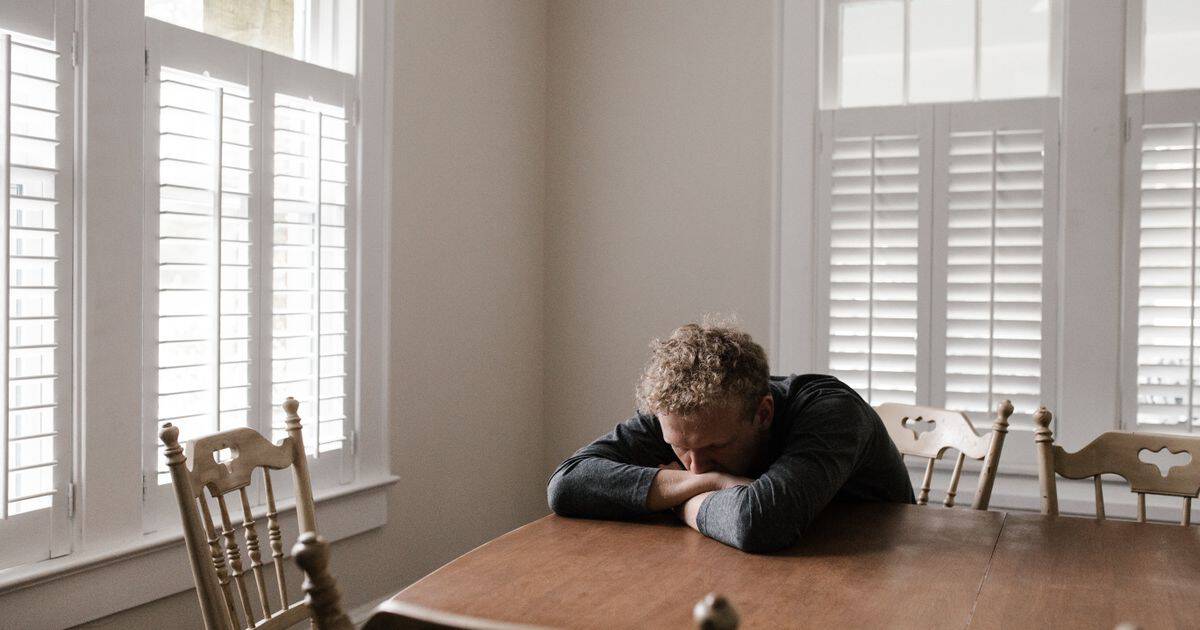
When your wife is depressed and blaming you, the blame is usually not a considered verdict on you as a husband. It is the last bit of energy she has, pointed at the only person in the world she is allowed to be this awful with, and underneath it is a woman saying I am drowning and I need to know you are still here. Defending yourself or trying to fix her lands as one more failure notice, so the blame gets louder.
What to do tonight: do not answer the content of the blame. Answer the thing underneath it, and tell her you are on her team and not going anywhere.
You come home and you can feel it before you get your shoes off. The house is heavy. She is on the couch, or in bed, or standing in the kitchen not doing the thing she is standing there to do. You say something small. How was your day. And it comes back at you. You never ask. You do not care. You are on your phone. You are the reason she feels like this.
And here is the part nobody says out loud. You have started to believe her.
I have sat across from a lot of husbands in this spot. Same look on all of them. Tired, guilty, a bit angry underneath, and not sure which of those they are allowed to feel. I have also been the man in that spot, badly, and I will tell you about it. So this is what is actually happening when a depressed wife turns on her husband, because it is not what it looks like from inside the house.
What depression does inside a marriage
Feeling more distant than you used to?
Talk it through with Figlet right now. Private, judgment free, built on 17 years of couples therapy.
Depression is not sadness. Sadness has a direction. What I see in the room is a nervous system that has gone into collapse. What is the point, I will not even try. Numb, gone inward, pulled under the covers. From the outside it looks like she does not care. From the inside, being enough for you matters so much to her that she cannot bear to be seen failing at it, so she goes away.
If you are the one who has gone under like this, with no motivation to do anything, I wrote a piece for you too.
And then something happens that you did not expect. She comes back out swinging.
Is it depression, or is she just angry with me?
Everyone has flat weeks. Depression is different in how long it lasts, how deep it goes, and how much of life it touches. Clinicians generally look for symptoms that persist for two weeks or more: loss of interest in the friends and plans that used to light her up, flat eyes and a flat voice, sleep and appetite changing, everything taking enormous effort.
The other tell is where the heaviness lives. If the shutdown shows up in every part of her life and not just in the bond with you, at work, with her friends, in her own body, you are looking at depression, and the blame is riding on top of it. If it lifts the moment you are out of the room, the pain is more about the two of you, and that is a conversation worth having too.
Why she blames you
Sitting directly in that much hopelessness feels like dying. So the nervous system does the only thing it can to get off the floor. It rises up and attacks. You are the problem. You never. You always. Righteousness is a shield. If I push you away and blame you, you cannot see how broken I actually feel.
That is what the blame is. It is not a considered verdict on you as a husband. It is the last bit of energy she has, and it is pointed at the only person in the world she is allowed to be this awful with. Underneath it, nearly every time, is a woman saying I am drowning and I need to know you are still here.
I want to be clear that this is a map, not an excuse. But you need the map, because without it you are going to do the thing every husband does.
The thing that makes it worse
You try to fix it.
You suggest she see someone. You point out that you did do the dishes. You bring home flowers, take the kids out, say calmly that it is not fair to be blamed for her mood. Every one of these is reasonable. Every one lands as a failure notice. Even if your advice is good, what she hears is you are not good enough and you are failing at this too. She already believes that. It is the whole disease. So she contracts, or she comes at you harder, and now you are hurt too, and you go quiet or you go sharp, and round you go.
I call this the Waltz of Pain. Two people who love each other, each responding to the other’s pain in the exact way that produces more of it. Neither of you is the villain. The dance is.
I did this, and I know why
Years ago I was with a woman who went into a severe depression. Crying at work, crying at home. And I did everything a well-meaning man does. I gave her advice about her friends, about her job, about what she should do differently. I thought I was helping. She felt controlled and judged and labelled, an emotional wreck being managed by someone who could not stand to be near her sadness.
It took me a long time and a lot of my own work to see what I was doing. I grew up between a mother who was a bull and a father who collapsed, into drink and depression and disappearing. When someone I loved went sad, I felt panic, and I tried to fix her to soothe my own panic. My fixing was never about her. It was about me not being able to bear it.
If you are honest, some of your fixing is that too. You are scared. A partner who has gone somewhere you cannot follow is one of the most frightening things a person can live with, and men are not given many ways to say that. So it turns into logistics, or a slow withdrawal into work, or a resentment you feel guilty about because how can you be angry at someone who is ill.
You can. Being allowed to feel it is what makes it possible to stop acting it out.
What to do tonight
Not a plan. One thing.
The next time the blame comes, do not answer the content. Do not defend the dishes. Do not correct the record. Do not suggest therapy. The content is not the message. Answer the thing underneath it.
Look at her, take a breath, feet on the floor, and say something like:
I hear how heavy and dark and exhausting everything feels for you right now. It breaks my heart to see you in this much pain. When I try to fix it or explain myself, I can see it makes you feel more alone. I am going to stop trying to fix you. I am on your team and I am not going anywhere.
That is it. You will want to add a but. Do not add a but. You may get nothing back. You may get more blame. Say it again tomorrow. What you are doing is not curing the depression. You cannot. What you are doing is proving, over days and weeks, in the only language a collapsed nervous system can read, that reaching for you works. When that lands, and it does land, the blame loses its job. It was the only reach she had left.
Two lines I want you to hold
First. Blame is not abuse and abuse is not blame. If what is happening in your house has crossed into contempt, into being told you are worthless, into your children being used against you, that is a different conversation and you should have it with a professional, not an article. Depression explains a lot. It does not explain everything.
Second. You are not her treatment. You can be a safe, steady floor for her to stand on. You cannot be her therapist, and trying to be turns you into her parent, and there is no intimacy left in a marriage where one person is managing the other. She needs help that is not you. The most loving thing you can do is refuse to be her only lifeline, because a lifeline one man wide will snap, and then you are both in the water.
What if she refuses help?
You can see she needs help. She says no, or I am fine, or nothing at all. That refusal is data, not verdict. It usually means the topic has become tied to unbearable shame, so pushing harder drives her further underground. Do not issue ultimatums. To a depressed person, get help or I am leaving translates as perform wellness or lose your marriage.
Make the next step small and concrete instead. Offer to find a name, to book the first appointment if she wants you to, to drive her there and sit in the waiting room. And get help for yourself in the meantime. When one partner starts working on their own side of the loop, the whole system has to reorganize.
Look after yourself too
Bonded nervous systems catch each other’s states. If you are losing sleep, appetite or interest, that is your cue to get your own support now, because you cannot co-regulate anyone from an empty tank. You absolutely deserve to process your own feelings about this. Just not with your depressed wife as your audience. A friend, a sibling, your own therapist: someone who can hold this is really hard without it turning into a competition with her pain.
If caring for her has left you numb or quietly resentful, I wrote about compassion fatigue in relationships and how both of you come back from it.
When it is an emergency
Some situations are beyond what love and patience can hold. Get help right away if she talks about wanting to die or everyone being better off without her, describes a plan, starts giving things away, or can no longer eat, sleep or take care of basic needs. Ask directly. Asking whether she is thinking about suicide does not put the idea in her head. It tells her you can bear to hear the answer. In the US, call or text 988 together, or call 911 if there is immediate danger, and stay with her until help arrives. Outside the US, contact your local emergency number.
Frequently asked questions
Why does my depressed wife blame me for everything?
Sitting directly in that much hopelessness feels like dying, so her nervous system rises up and attacks to get off the floor. Righteousness is a shield. If she blames you, you cannot see how broken she actually feels. It is pointed at you because you are the safest person she has.
My wife blames me for her unhappiness. Is it my fault?
Depression is not something you caused by forgetting the dishes. You are, though, part of a pattern between you, and you can change your side of it: stop defending, stop fixing, and keep showing her that reaching for you works. Neither of you is the villain. The dance is.
Can my wife’s depression make me depressed too?
Yes, and this is underrecognized. Sustained disconnection from the person you are closest to produces a kind of grief that can look a lot like depression. If you notice it in yourself, get your own support now rather than waiting for her to get better first.
How long does it take for things to get better?
It depends heavily on whether she gets effective treatment from a licensed professional. Recovery is not linear. Expect good days followed by setbacks. What you are watching for is a slow widening of her window, not a straight line from broken to fixed.
What I tell the husbands in that chair
You are not failing. You are in a pattern that has a name, and patterns with names can be changed. Your job tonight is not to fix your wife. It is to stop dancing.
If you want help with the words for tonight, that is what I built Figlet for. Tell it what she said and what you said back. It will show you the cycle you are both in and give you something to say that does not feed it.
Keep Reading



Feeling more distant than you used to?
Figlet is relationship coaching built on 17 years of couples therapy. Talk through what is happening the moment it matters, get a clear next step, and stop circling the same fight. Private, judgment free, ready whenever you are.
Free to start. No credit card needed.
Figs O'Sullivan
Founder · EFT couples therapist
“What I would tell you at 10pm, if I could.”