One bit of advice that has emerged from the last 50 years of the personal development movement is to ask for our needs to be met.
As a therapist, this drives me crazy.
Of course, it’s not the asking that’s bad. It’s the how of it that mucks it all up. Because in the very moment you’re inspired to ask another to adjust their way of being in the world, you are probably behaving in a threatened/threatening way that is not easy to hear or empathize with. You are more likely to make things worse.
How do you communicate a desire for change?
Start by sharing your experience.
For example, my wife Teale used to accidentally leave the key in the front door, and it became a big issue for us. I’d see the key in the knob, my heart would race, and I’d react. I needed her to stop.
Asking her to meet my needs sounded like this: “Teale, you left the key in the door again. You know how dangerous that is! I’ve asked you before and I will ask you again, please don’t do that!”
Sharing my experience sounds like this: “Teale, when I see the key left in the door, I get really worried. I freak out a little inside at the thought of how exposed our family is to being robbed or worse. I also get worried that by sharing this, you’ll either feel criticized or not care, so I end up feeling helpless. It’s a big deal for me.”
Which one do you think is better for our relationship? Hint: it’s not the one where I criticize her and then tell her how to fix it. Nobody likes that. Ever. My chances of being heard increase when I can share my experience of what happens inside me when I see the key left in the door.

If only it were that easy to resolve all of your conflicts! Cobble together the right words and lay them lovingly at your partner’s feet. But that’s not the way we’re built.
You can’t expect to dive right into sharing your experience without first reacting to it. Humans are hardwired to react to things that cause pain, physically and emotionally. It’s like thinking you can train yourself to never flinch. Not gonna happen, my friend.
You should never underestimate the level of pain you can experience when you feel your partner hasn’t met your needs. It’s because your partner is so important to you that an everyday argument becomes a full-fledged war of attrition and detente.
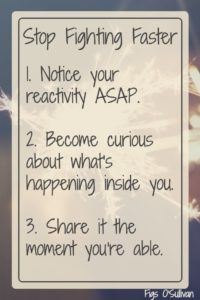
This means that during the precise moment you need to be present and aware, you’re going to be in some type of pain. And when you’re in pain you react. You’ll feel the least able to share, but press on. Notice your reactivity, become curious about what’s happening inside you, and then share that experience with your partner.
You just can’t expect to do this sans temporary reactivity. It’s the hardest concept for my clients to accept and surrender to (and sometimes for me, too). Everyone wants to avoid conflict or moments of disconnection. But that’s impossible, and it would be bad for your relationship if you did. Moments of disconnection, while painful, are opportunities to feel, share, and love up the most vulnerable parts of each other.
If you were watching the two of you in a film, you could see your shared cycle of pain clearly. And it might even be more comedy than tragedy. The trigger, your reaction to the trigger, your partner’s reaction to your reaction, ad infinitum.
But when you’re in the moment, you’re feeling it and there’s nothing funny about it. Your brain gets hijacked when you feel threatened and it causes you to react. You feel unimportant or rejected or hopeless. You don’t feel heard, considered or valued. You judge your partner for all the ways they fail and disappoint you. You decide your pain is their fault. You blame, criticize, shame, or withdraw.
What I’m asking you to do is allow yourself to have your reaction, and then move on to the next step to stop the cycle: notice your reactivity ASAP, become curious about what’s happening inside you, and then share it the moment you’re able.

It won’t be easy. And you will fail. But it is only through your failure that the opportunity arises to practice shifting your gaze from A) the absolute certainty of what another must do so you aren’t triggered now or ever to B) your own internal activation and the reasons you feel the way you do.
With practice you’ll improve the time it takes to move through it, but you will always react. Use your reaction as an invitation to ask yourself, What is it in me that’s triggered right now and can I share that underlying part instead?
You’ll get plenty of practice because … shit happens.
You’d think that two conscious couples counselors would have this relationship stuff perfected. But here’s what it looks like for me on the receiving end of Teale’s reactivity:
If I tell her I’ll be home at 7 pm and then stroll in at 8 pm, Teale might say, “What time do you call this? I need you to be home when you say you’ll be home.”
It’s understandable that she’s upset but the problem is that I don’t hear what Teale is saying: that it was hard for her to not know when I’d be home because I’m important to her. Instead, I hear that I’ve disappointed my wife, reinforcing my hidden feelings of inadequacy and powerlessness. As a consequence, I’ll react defensively to avoid feeling the pain of not being enough. I may minimize her concern, shut down, withdraw, or criticize her.
Ouch! The situation goes from bad to worse.
Teale was longing for me to come home, feeling anxious and not important enough to be met on time, and now that we are finally together, we are in a fight. It’s tragic.

This is the moment when Teale and I both take steps to stop our cycle of pain:
1. See the cycle we are stuck in together.
2. Become aware of our own vulnerable experience that got activated because being connected is so important.
4. Acknowledge how our own behavior has contributed to this painful moment between us.
5. Share and be receptive to each other about that vulnerable internal place that gets touched in disconnected moments.
Afterwards Teale may say, “When you came home an hour late, I felt like I wasn’t considered and it was hard for me because feeling considered by you means a lot to me. Thinking I didn’t matter made me sad. Figs, I get that this is what was happening inside me underneath the disapproval.”
The trick is to share more about yourself and focus less on requests, descriptions and questions for your partner.
Now that I’ve hammered my point home, I’m throwing in a surprise twist.
There are two scenarios where you can ask for your needs to be met.
Scenario one: You both feel so completely met and unconditionally loved by the other that there isn’t a whiff of threat.
If you find yourself in this scenario, you can ask each other for every need you ever longed to have met. Why? Because if you’re looking at each other this way, your limbic system won’t feel any threat. And if the threat is not there, the part of you that can be perceived as threatening is also gone.
Scenario two: You are so deeply immersed in your own vulnerability and pain that there’s no blame in the equation.
Please note: This scenario assumes you both are practiced in seeing your past conflicts as jointly created misadventures borne out of your importance to each other and not as moments of condemnation.
If your painful thoughts and feelings don’t end in because of you, (expressed or implied) you can ask for your needs to be met. Since your focus is on your deep vulnerability, your partner is less likely to perceive you as a threat. And the fear that you need to overcome in order to turn toward your partner from this place of suffering can compel your partner to comfort and soothe you.
Ultimately, the goal is not to have a perfect relationship or never get into a fight. It’s to recognize what the disconnections are really about so you can end a fight faster, repair, and feel connected again. It’s only through feeling, acknowledging, and sharing these experiences that you can give and receive love and feel the emotional bond you’ve longed for all your life. And just maybe get some of those needs met.