
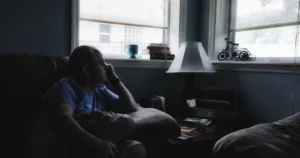
Photo by Vitaly Gariev on Unsplash
Photo by Vitaly Gariev on Unsplash
You are sitting on the edge of the bed at 11:30 at night, replaying the conversation that happened three hours ago. You brought something up. Something small, maybe. A comment he made in front of friends. A promise he forgot. The way he picked up his phone at dinner again. The bill on the counter you had already asked about twice.
You were not looking for a courtroom battle. You wanted him to say four words. I hear you. Sorry. That was it.
Instead you got a legal brief. A speech about how hard he works. A list of the things you do that are worse. Or the opposite, that specific quiet that feels like a wall sliding down the middle of the house while he stares at his phone. Your face went hot. Your chest tightened. And then the loneliness landed in your bones, the particular loneliness of being in a room with the person you married and feeling like you are standing on sand.
You searched my husband won’t take responsibility because living with someone who cannot admit a single fault is starting to make you feel crazy. You are not crazy. You are reading a real pattern. And almost everything the internet is going to tell you about it is pointed at the wrong target.
I have been a couples therapist for over seventeen years. I want to show you what is actually happening underneath his defensiveness, why demanding he own it is the one move guaranteed to make it worse, and what the real shift looks like. Not the bumper sticker version. The clinical one.
Recognize yourself in this?
Talk to Figlet about what happens when you try to bring something up with your husband. AI relationship coaching grounded in Figs O’Sullivan’s work, LMFT. Free to start, no credit card.
What His Defensiveness Actually Is
When talking turns into the same fight
Talk it through with Figlet right now. Private, judgment free, built on 17 years of couples therapy.

The dominant story about a husband who will not take responsibility goes like this. He is immature. He is arrogant. He is emotionally unavailable. Maybe he is a narcissist. The internet will hand you five tabs full of that framing before you finish your coffee.
In the therapy room, I see something completely different.
When he defends, explains, minimizes, lists your sins, or vanishes into the other room, it is almost never cold indifference. It is a nervous system firing a protective program at high speed, long before his thinking brain gets a word in. Grounded in attachment theory, adult partners regulate each other the way a caregiver regulates an infant. When the bond wobbles, the amygdala lights up before reason has a chance.
To you, his reaction looks like he does not care. Underneath the armor, his body is registering a very specific message. I have failed her. I am a disappointment. I am not enough for the person I love most.
That is the wound. And the pain of that wound is so unbearable that his body does the only thing it knows how to do. It armors. It gets logical. It starts counting your mistakes. It goes flat. It leaves the room.
I do not use the word avoidant in my clinical work. Avoidant describes behavior and explains nothing. I call this person the Reluctant Lover. Reluctant tells the truth. He wants closeness. He is also terrified of it. His deepest wound is not being left. It is being seen fully and found lacking. The answer no, you are not enough is already stapled to the back of every question you ask him. His whole protective architecture exists to stop him from feeling that word land again.
The refusal to take responsibility is not a character flaw. It is a survival strategy. A brilliant protector part that decided a long time ago that admitting fault is the same thing as being annihilated.
When that protector turns the fight around on you, I wrote about what to do when my husband starts fights and then blames me.
Why Demanding He Own It Makes It Worse
Here is the hard part. Every couple that walks into my office wants the same thing. They want the other person to take responsibility first. Every single one.
You think: if he would just admit what he did, I could finally relax.
He thinks: if she would stop treating me like a defendant, I could consider what she is actually feeling.
That is a stalemate the system itself creates. And the order of operations matters enormously.
Demanding someone take responsibility while they feel actively judged is biologically impossible. When his nervous system reads threat, his prefrontal cortex goes offline. His brain enters fight, flight, or freeze. You cannot reason with a system that is in survival mode, because the system that does reasoning is not online.
The more you ask, explicitly or implicitly, the more threat his body registers. The more threat, the deeper the armor. The deeper the armor, the more it looks like he does not care. The more it looks like he does not care, the more you have to escalate just to feel like your pain is being seen at all.
Responsibility is not a prerequisite you can demand before love can begin. It is an emergent property. It arises through safety, not before it. Give him stable ground beneath his feet and the walls drop on their own. Keep pressing the courtroom button and he will keep hiring better lawyers.
The Dance You Are Both In
What you are living inside is a closed loop. In the Empathi framework I call it the Waltz of Pain, and it takes two to waltz.
You feel disconnected, unprioritized, or alone. You protest that pain the only way the body knows how, through criticism, questioning, listing evidence, raising the temperature. You are not nagging. You are protesting for closeness with the fire alarm going off.
He hears your protest not as a request for love but as proof he has failed again. His body translates your words into I am bad. To protect himself from falling into unbearable shame, he defends, explains, minimizes, shuts down, or walks away.
His retreat lands in your body as my feelings do not matter to him. He is not here for me. So you intensify. More evidence. More heat. More proof he is failing you. Which pushes him deeper into defense. One, two, three. One, two, three. A rhythm of misunderstanding that neither of you chose and both of you are keeping alive.
Neither of you is the villain here. Both of you are terrified. Both of you are using protective strategies that guarantee you will receive the exact rejection or abandonment you were trying to avoid.
In the archive I describe this with a diagnostic rule. If one of these four things is present, all four are present. I am hurting. I am reacting. You are hurting. You are reacting. Most couples only see two of them. Usually: I am reacting because I am justified, and you are reacting because you are unreasonable. The whole system comes into view only when you can hold all four at once.
I have written more about this pattern in Avoidant Partner Won’t Commit, where the same protective architecture shows up around the future rather than around apology. It is the same wound. Different surface.
The Two Questions Underneath Every Fight
I tell every couple that the bonded body only ever asks two questions, and never in words.
Are you there for me? Am I enough for you?
You are feeling the first one loud in your body right now. He is feeling the second one loud in his. You are both answering the same threat with opposite moves. You reach. He retreats. You press for responsibility because you need to know he is actually in this with you. He refuses responsibility because taking it would confirm the thing he most fears, that he is a disappointment to the person he loves most.
This is the piece almost no article names. His refusal to apologize is not evidence that he does not care. It is evidence that he cares so much that failing you feels unsurvivable to his nervous system.
If that sentence lands even a little, keep reading. Because the shift is not what you think it is.
The Shift That Actually Moves This
Here is what I watch move the needle in the room, after years of trying every other angle. It is not more clarity. It is not better communication tools. It is not an ultimatum.
It is one of you stepping out of the choreography first.
Not stepping out of your truth. Not pretending the thing he did was fine. Stepping out of the protective move that your body has been using to try to get through to him. Which, for most pursuing partners, is heat. Evidence. The courtroom.
I know how unfair that sounds. You are the one who was hurt. Why should you move first?
Because you can. His nervous system right now cannot. His system is in freeze or fight. Yours is activated but still capable of reflection, which is probably why you are the one reading this article at 11:30 at night and he is not. Someone has to put a floor under the system before either of you can stand on it. That is not fairness. That is physics.
What stepping out looks like, specifically, is naming what is underneath your protest instead of leading with the protest itself. Instead of you never take responsibility for anything, try when that happened today, I felt alone in a way that really scared me.
That is not softer. It is more exposed. It gives him access to the actual signal underneath your protest, which is not that he is a failure, but that you are hurting and reaching for him. His protector part cannot defend against your vulnerability the same way it defends against your prosecution. The sword he keeps swinging has nothing to swing at.
When he gets even one glimpse of your pain without the frame of his failure wrapped around it, something in his body softens that no amount of pressure could reach. The ground steadies. And on steady ground, something extraordinary happens. Responsibility emerges on its own, without being coerced.
I have watched it hundreds of times. The husband who could not say sorry in sixty-two fights says it, quietly, the first time his wife lets him see her hurt without indicting him for it. He is not performing. The wall came down because the gun was no longer pointed at him.
Ready to work on this?
Figlet is AI relationship coaching grounded in attachment science and Figs O’Sullivan’s clinical work, LMFT. First messages free, no signup.
What This Is Not
I want to say this clearly, because the move I am describing gets abused by people who should not be using it.
This is not about making excuses for behavior that is actually harmful. If he is contemptuous, cruel, controlling, or physically unsafe, the frame I am describing does not apply. That is a different conversation and a different kind of help.
If the pattern includes lying about where he was or what he did, I wrote separately about when to leave a lying spouse.
This is also not about carrying all the emotional labor of the relationship on your back forever. Stepping out of the choreography first is a move you make to break a stuck loop, not a permanent assignment. In a functioning bond, both of you learn to do this. He learns to turn toward your pain instead of defending against it. You learn to protest from your tenderness instead of your prosecution. Over time, the Waltz of Pain gets replaced by a different rhythm entirely.
And one more thing. His pattern of refusing responsibility did not start with you. It was built in his body long before he met you, probably in a childhood home where mistakes meant something unsafe. Shame, humiliation, withdrawal of love, a parent going cold. His body learned early that admitting fault was dangerous. You are inheriting that nervous system. You are not the cause of it.
If you want to name your own pattern before you try this with him, you can take the free Figs Quiz. It takes about five minutes and will show you which half of the choreography you are running.
What Changes When He Finally Softens
I want to tell you what I see on the other side of this work, because the picture matters.
When a husband who could not take responsibility finally can, it does not look like him groveling. It looks like him being able to stay in the room with your hurt without having to make it mean something about his worth. He can hear that hurt me and respond with tell me more instead of here is why you are wrong.
It looks like him being able to say I messed up. I see it. I am sorry without a defense clause attached. It looks like him turning toward you when he sees your face fall instead of pretending he did not see.
That shift is possible. I have seen it in the stuckest couples. But it does not come from pressure. It comes from the slow, patient construction of a different kind of ground underneath him, one where his nervous system stops reading your presence as a verdict.
Patterns can shift. Not through willpower. Not through understanding them intellectually, though that helps. They shift through felt, embodied experience. When he drops into vulnerability and you stay, and do not shame him, something changes in his body. That is the nervous system learning something new. I have written more about this in Can You Change Your Attachment Style.
Common Questions
Why does my husband get defensive when I bring up something small?
Because to his nervous system, there is no such thing as a small complaint. Every piece of criticism, however gently delivered, lands as evidence that he has failed you. His body reacts to the full weight of I am a disappointment even when your actual complaint is about a forgotten errand. The size of the defensiveness is proportional to the size of the shame, not the size of the issue.
Is refusing to take responsibility a sign of narcissism?
Sometimes, but far less often than the internet suggests. Most men who cannot take responsibility are not narcissists. They are men whose nervous systems were shaped early to associate admitting fault with annihilation. True narcissism involves a pattern of exploitation, lack of empathy, and grandiosity. Shame-driven defensiveness looks similar on the surface but is driven by terror, not entitlement. The difference matters for how you respond.
How do I get my husband to apologize without starting a fight?
Stop trying to get him to apologize. Try, instead, to let him see your pain without the frame of his failure attached. Lead with what is tender underneath your protest, not with the prosecution. That really hurt me today lands differently than you never take responsibility. When his protector part has nothing to defend against, apology often emerges on its own, usually faster than you expect.
What if he still refuses to take responsibility even when I soften?
Softening once is not a magic key. Nervous systems take time to trust that the ground has actually changed. If you have been in prosecution mode for years, he will keep bracing for a while. Give it weeks, not days. And consider whether you need a third nervous system in the room, a skilled therapist who can hold both of you while the pattern unwinds. Some loops cannot break open on their own.
Can couples therapy actually change this pattern?
Yes, when the therapist is trained in attachment-based work and does not fall into siding with the more expressive partner. The withdrawn partner, once he can feel the therapist is not there to prove him wrong, often moves faster than anyone expects. The work is not teaching him to apologize. It is building enough safety that his protective architecture no longer needs to run twenty-four hours a day.
What to Do Next
You came here looking for a way to make him take responsibility. I am asking you to try something harder and more effective, which is to stop demanding it and start building the conditions in which it can emerge. That is not fair. It is also the move that works.
Do not just close the tab on this.
Bring what surfaced here into a real conversation. Figlet coaches you through it, grounded in Figs O’Sullivan’s work, LMFT. Free to start.
He is not refusing because he does not care. He is refusing because he cannot bear what caring is costing him. Change the terms and watch what moves.
Keep Reading


When talking turns into the same fight
Figlet is relationship coaching built on 17 years of couples therapy. Talk through what is happening the moment it matters, get a clear next step, and stop circling the same fight. Private, judgment free, ready whenever you are.
Free to start. No credit card needed.
Figs O'Sullivan
Founder · EFT couples therapist
“What I would tell you at 10pm, if I could.”





