Am I the narcissist? Almost certainly not in the clinical sense. Narcissistic Personality Disorder is rare and rigid, and the word your partner threw at you tonight has become the internet’s favorite label for any partner who hurts or disappoints us. But being called one is still information worth taking seriously, because it usually means your partner feels unseen by you, and some of your own patterns may be part of why. If you want help with the fight you just had, tell Figlet what happened and see the pattern.
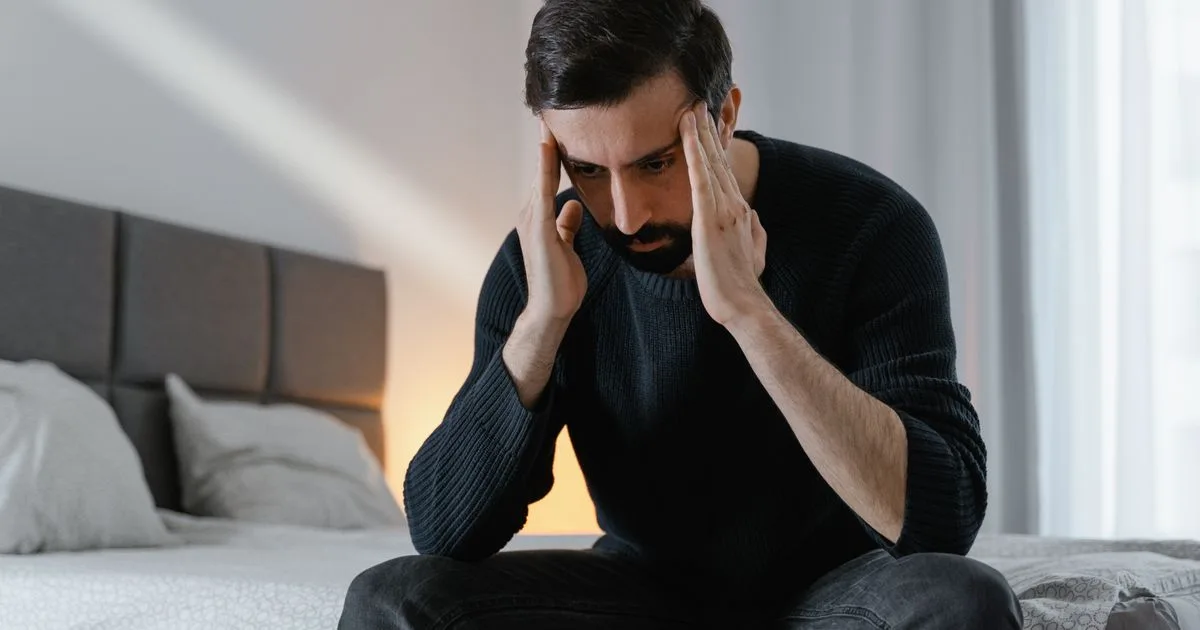
It is late. The fight is over, or it just went quiet. Somewhere in the middle of it your husband, your wife, your boyfriend said it: you are such a narcissist. Now they are asleep or pretending to be, and you are lying there with your phone, typing “am I the narcissist” with a cold feeling in your stomach, half afraid the answer is yes and half convinced the real narcissist is asleep in the next room.
Am I the narcissist, or is my partner just using the word?
Stuck in the same argument again?
Talk it through with Figlet right now. Private, judgment free, built on 17 years of couples therapy.
I have been a couples therapist for seventeen years. In that time, sitting with thousands of people in pain, I have encountered five or six people who met the diagnostic criteria for Narcissistic Personality Disorder. Five or six. NPD affects roughly 1 to 6 percent of the population, depending on which study you read. It is a pervasive, inflexible pattern of grandiosity, need for admiration and lack of empathy that shows up everywhere, not only in one relationship during a fight.
Narcissistic traits are a different thing, and every one of us has them. Have you ever said something cruel during an argument that you would never say to a stranger? Have you ever shut down because the vulnerability felt like too much? Have you ever made everything about your own pain when your partner was trying to tell you about theirs? Congratulations. You displayed narcissistic traits. That doesn’t make you a narcissist. It makes you a human being whose nervous system got overwhelmed.
The very fact that you are asking, and that the question hurts, is a capacity that pervasive NPD tends to block. That is not a clean bill of health. It is an invitation to get curious about your own protectors, where they came from, and what they are guarding against. If you want the full clinical picture, I lay it out in what a narcissist actually is.
Why does my partner keep calling me a narcissist?
Every partner who disappoints you gets called a narcissist. When a fight gets hot, the word stops being a description and becomes a weapon that ends the argument with a verdict instead of a feeling. I call this the Story of Other: each person points a flashlight at the other and builds an airtight case. It is seductive because it is always partly true. But the story leaves the storyteller out of it.
My wife calls me a narcissist, my boyfriend says I’m a narcissist, my partner thinks I’m a narcissist: the sentence changes, the mechanism does not. Underneath the label, your partner’s nervous system is asking one of two old questions. Are you there for me? Am I enough for you? When your partner says “you are a narcissist,” the translation is usually something like: you don’t see me. My pain doesn’t seem to reach you. I am not enough to you. It is a clumsy, hurtful protest, and impact is bigger than intention in both directions, but it is a protest, not a diagnosis.
Here is a couple I see versions of constantly. A wife tells her husband she felt alone at a party. He hears: you failed. His shame activates. Instead of saying “I’m sorry, that must have been hard,” he says “That’s ridiculous, I was right there.” She hears: your feelings don’t matter. She escalates. He shuts down further. By the end of the evening she is convinced he lacks basic empathy, and he is convinced she is impossible to satisfy. Underneath his coldness was a question his body was asking: am I enough for you? Underneath her certainty that he was a narcissist was the other question: are you there for me? Same fear, two different protectors.
What is actually happening in me when I react like this?
Shame is a body event before it is a thought. When your partner brings you a hurt, it often lands not as information but as a verdict: I have failed you. Your chest goes cold and the oldest parts of your brain take the wheel. From there the nervous system has four exits, what Donald Nathanson mapped as the Compass of Shame: attack other, attack self, withdraw, avoid. Three of those four look narcissistic to a distressed partner. The one who attacks, the one who goes stone cold, the one who minimizes your pain. These are survival strategies, not a personality disorder. They come from heartbreak, not entitlement.
That explains it. It does not excuse it. So turn the flashlight 180 degrees. Can you access empathy when it costs you something, without making it about yourself? Does repair actually happen, meaning you go back to the rupture, own the impact and change the behavior? Can you say “I was wrong” in a small moment without weaponizing it (“Fine, I’m wrong, I’m always wrong, are you happy now?”)? When they tell you about a hurt, do you hear it, or start building your defense and keeping score?
If some of that stung, good. That sting is the part of you that can change. If you are thinking, “I’m never an ass when I fight,” that may be your biggest problem of all. The partner who claims to be above reproach is the one I worry about most.
Have I ever been the one who looks like the narcissist?
Yes, and I can name exactly how. The most common way I am the problem in my marriage looks like this. Sometimes when I feel alone and burdened, I react by being a blaming, criticizing, disapproving ass to my wife. Sometimes it is so subtle I don’t even realize I’m doing it. When she responds with understandable hurt and her own reactivity, I feel even more justified, and I turn up the volume.
What makes me remotely tolerable to live with is that I can see, usually in retrospect, that I am reacting to the pain of feeling alone in the world, and it was there long before I met her. In 58,221 completed relationship assessments, 33% named “alone” as their deepest feeling when love isn’t working. More than rejected. More than abandoned. A lot of what gets called narcissism is people feeling alone and handling it badly.
Am I the narcissist or the victim?
Usually neither. Pop psychology has created a binary, narcissist or victim, and once you accept it you cannot see the relationship as a system you are both in. In 58,221 assessments, 74.1% of the 6,159 couples where both partners completed were in the pursue and withdraw cycle. I call the pursuer the Relentless Lover and the withdrawer the Reluctant Lover. To the pursuer, the withdrawer looks cold and unempathic, a textbook narcissist. To the withdrawer, the pursuer looks controlling and impossible to please. Both are terrified. That is the Waltz of Pain, and it is why “my husband says I’m a narcissist but I think he is” makes so much sense from both chairs.
There is one question that cuts through it. Over the last two years, have you become more yourself in this relationship, or less? A painful loop flattens both partners. Abuse shrinks one partner while the other expands. And watch for one shape: if you have been belittled for months, finally snap, and your partner points at your reaction as proof that you are the abusive one, clinicians call that reactive abuse. Your reaction still deserves repair. It also did not come from nowhere.
If this is landing close to home and you want to work out which dance you are in, describe the last fight to Figlet and it will show you the cycle.
When is it not a dance?
If you control your partner’s money or phone, threaten them, block their exit, or they are afraid of you, own that, and get individual help from someone who works with coercive control, not couples therapy. And if you are the one called a narcissist every time you set a boundary, or you are afraid of your partner, that is a safety question, not a self-examination. Call the National Domestic Violence Hotline at 1-800-799-7233, or text START to 88788, today.
What do I do when my partner calls me a narcissist?
Not in the middle of the fight. Wait until it is quiet, then say one thing about your step only, word for word: “I’ve been thinking about what you called me. When I get scared that I’m failing you, I get defensive and I stop hearing you, and I know that makes you feel like you don’t matter to me. I’m sorry for my part. I want to understand what it’s been like for you.”
No “but.” Not “I’m sorry you felt that way,” which is the Representative wearing an apology costume. You are not confessing to a diagnosis. You are showing their nervous system there is a way to be in this that doesn’t require armor.
For the partner who called them a narcissist
Your pain is real. But telling someone they are a narcissist says: you are fundamentally broken. A shame driven nervous system protects louder and harder. You diagnose, they defend. The relationship dies by certainty. Try describing instead: “when you went quiet after I told you how I felt, I felt completely alone.” And look for the marker that matters: can your partner ever, in any moment, be genuinely small, scared and open with you? If the answer is yes, even rarely, you are likely not dealing with NPD. I wrote the other side of this question in is your partner really a narcissist.
Where to go from here
The question was never really “am I the narcissist.” It is “what do I do when I get scared, and what am I so scared of?” If the honest answer is that you have been part of the problem, am I the problem in my relationship walks you through finding your step without drowning in it. If the word came out of a fight where names were flying both ways, read when your partner calls you names during fights.
Frequently asked questions
How do I know if I’m the narcissist?
Look at pattern, not incidents. Can you feel empathy when it costs you, repair after a rupture, admit you were wrong in small moments, and does the behavior soften when the relationship feels safer? If yes, you are dealing with traits that can change, not a disorder.
Can a narcissist ask if they are a narcissist?
Rarely in a way that leads to change. The defended self is built so it does not have to see itself. Lying awake with the question hurting is a capacity the disorder tends to block, though it is not a free pass to stop looking at your own behavior.
Why does my partner keep calling me a narcissist?
Most often because they feel unseen and the label is the loudest protest available. If the word comes out every time you set a boundary, alongside control or fear, treat that as a safety issue.
Am I the narcissist or the victim?
In most relationships, neither. Two people are hurting and reacting, and each looks narcissistic to the other. Ask whether you are becoming more yourself or less; if one partner is shrinking while the other expands, that is not an ordinary cycle.
Can a narcissist change?
Narcissistic traits soften when the relationship gets safer, and cycles can be interrupted. With genuine NPD, change takes long term individual therapy and is slow. Do not wait for transformation or promises; look for behavior, sustained over time.
If you want help with the specific fight you just had, I built a coaching tool called Figlet. It is coaching, not therapy. You tell it what happened, it shows you the pattern the two of you were caught in, and it gives you one line to say when you walk back into that room. It is free to start tonight.
Keep Reading



Stuck in the same argument again?
Figlet is relationship coaching built on 17 years of couples therapy. Talk through what is happening the moment it matters, get a clear next step, and stop circling the same fight. Private, judgment free, ready whenever you are.
Free to start. No credit card needed.
Figs O'Sullivan
Founder · EFT couples therapist
“What I would tell you at 10pm, if I could.”