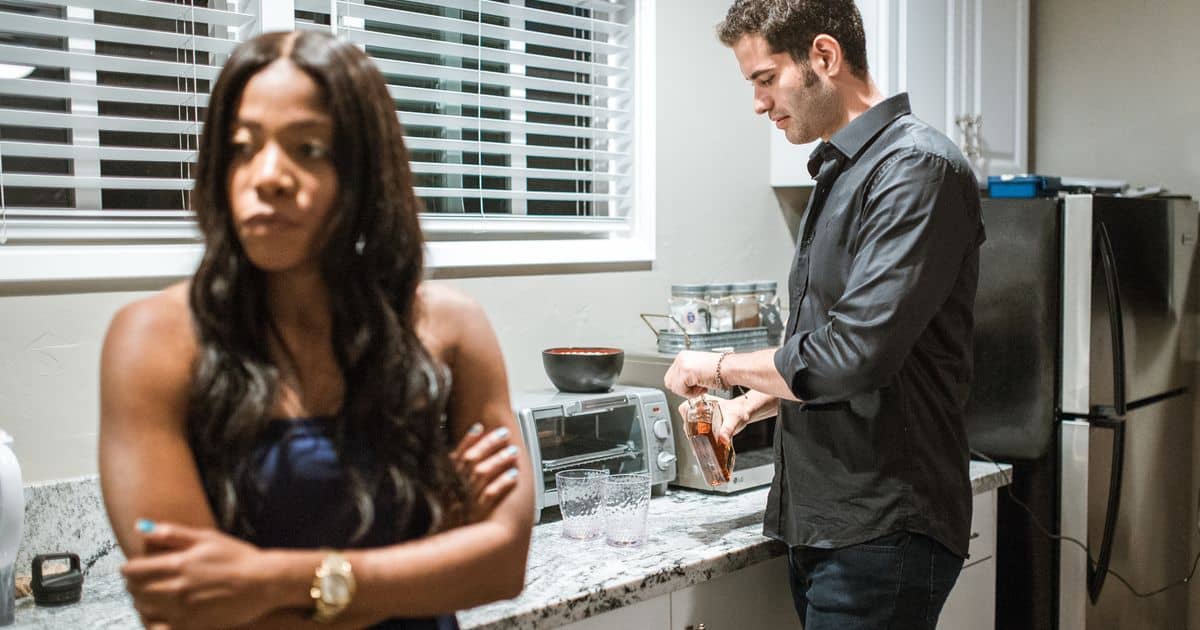
When your husband talks bad about you to his family or friends, he is usually looking for comfort, or for allies, outside the marriage, for pain he does not know how to bring to you. Whatever his reason, it breaks the first rule of a couple: what happens between the two of you is not content for other people. It can be repaired, but only if he is willing to bring the complaint to you instead of to them.
Maybe his sister let something slip at a birthday party, a detail from last Tuesday’s fight that only two people should know. Maybe you walked into his mother’s kitchen, felt the temperature drop, and knew she had already heard the worst version of you. Now he is asleep, and you are wondering if you are crazy for feeling this sick about it.
You are not crazy. If you want help finding the words before you say the wrong ones, tell Figlet what you found out and it will give you one line to say to him.
Why does my husband talk bad about me to his family?
Stuck in the same argument again?
Talk it through with Figlet right now. Private, judgment free, built on 17 years of couples therapy.
I have been a couples therapist for seventeen years, and in-law issues are one of the top three reasons couples walk into my office. In my guide to setting boundaries with in-laws I call it the information boundary, and it is the most commonly violated one. When your partner calls their mother after a fight to vent about you, they are not “processing.” They are recruiting. They are building an alliance outside the relationship, and they are doing it with someone who is biologically predisposed to take their side.
That is the hard version. The softer version is often true at the same time: he is in pain and does not know how to bring it to you. Often he is the withdrawer, what I call the Reluctant Lover. He cannot say the hard thing to your face, so the complaint leaks out sideways, to someone who will not get upset back. On Donald Nathanson’s Compass of Shame (withdraw, attack self, avoid, attack other), he is hitting two points at once. He avoids you, and he attacks you where you cannot hear it.
There are other drivers. His attachment to his family came first, his first experience of love, safety and belonging, and that wiring does not disappear when he says “I do.” Sometimes a friend is fishing. And sometimes there is contempt in it, the knowing little smirk in his voice when he tells the story about you. That is the dangerous one.
Is it normal for your partner to vent about you?
Some venting is normal. The question is not whether he ever talks about you. It is who he talks to, and what he is building when he does.
Venting that can be okay goes to a trusted friend or a therapist, where he owns his part and comes out of the conversation more able to turn back toward you. A therapist has no loyalty bias. A parent always does.
Venting that is not okay goes to his mother, his sister, your kids, or a coworker of the opposite sex. Your mother-in-law is not hearing a balanced account of a complex conflict. She is hearing her child in distress, and every maternal instinct she has is telling her that you are the threat. With a coworker, read my piece on emotional cheating. Its second stage, the Escalation, is exactly this: maybe you vent about your marriage. Each disclosure deepens the bond. Each disclosure also widens the gap between what this person knows about you and what your partner knows about you.
Why does it hurt this much when my husband talks bad about me to his mom or his friends?
Your nervous system is constantly scanning your partner and asking two questions: Are you there for me? Am I enough for you? When you find out he has been handing your worst moments to his mom or his friends, both questions get answered no, and in public. You were not even enough to be told to your face.
That is why it lands as betrayal and not rudeness. Shame is a body event. Your face goes hot. Your stomach drops into a cold hollow spot. The nervous system reads a public put-down from your primary attachment figure as something closer to banishment than feedback: you failed, and the village now knows. When he does it to your face in front of people, I cover that in my husband belittles me in front of others. Here you were not even in the room. You get the banishment with no chance to answer it.
In 58,221 completed relationship assessments, 33% named alone as their deepest feeling when love isn’t working. This is alone with an audience.
What is really going on between us?
In those same assessments, 74.1% of the 6,159 couples where both partners completed were in the pursue-withdraw cycle, and this fits it exactly. I call it the Waltz of Pain. You find out, and you pursue: you show him the text, you bring it up again on Tuesday and again on Thursday. You are the Relentless Lover, fighting for the couple. He hears “you are failing, you are not enough,” goes quiet, and says you are overreacting. Then he takes it where nobody gets upset back. He vents more. You find out more. The reach gets sharper. The retreat gets deeper. The actual enemy is the loop itself.
Can a husband really stop doing this?
A couple I worked with for about a year came in with the standard version of the family fight. He defended his mother reflexively. She had stopped attending family events because she felt invisible at them. They were one bad holiday away from separating.
We did not spend much time on his mother. We spent it on the two of them. On the moment he went quiet at the dinner table when his mother corrected his wife on how she handled their toddler. On the shame that flooded him and made him turn away from her in bed. On her grief, which she had stopped showing him because she did not believe it landed anywhere. Then he could finally say to her, “I freeze. I have always frozen with my mother. And when I freeze, I leave you alone in the room, and I know I do. I am sorry. I am working on it.”
That conversation changed everything. Not because the mother-in-law changed. She did not. He did. He called his mother the following week and told her that he and his wife had decided together that drop-ins were going to end. His mother cried. He let her cry. He did not collapse. His wife, watching this happen, felt something in her body she had not felt in years. She felt chosen.
Your husband may talk rather than freeze, but the knot is the same: he cannot yet tolerate disappointing his family, so he leaves you alone in the room.
One line has to be clear. If the badmouthing comes with control, with him cutting you off from your own people, turning the kids against you, watching your phone or money, or making threats, that is not a dance and couples work is not the first step. Call the National Domestic Violence Hotline at 1-800-799-7233 or text START to 88788, today.
What do I say to him tonight?
Not the Story of Other. Not “you always run to your mother” or “you trashed me to your friends.” That is the case against him, and he will defend against it. Say the Experience of Self, what happened inside you. In a calm moment, not at 1 a.m. with the screenshot in your hand, say this, word for word:
“When I found out you told your mom about our fight, I felt exposed and alone. I need what happens between us to stay between us, and I need you to bring it to me first.”
Then stop talking. Swap in “your friends” or “your sister” if that is who it was. If you want to see the dance before you start it, or rework the line for your situation, Figlet can help you find the words.
How does he fix it with his family afterward?
He corrects the record himself. Not you. The voice has to be the family’s own. It sounds something like, “I said things about her when I was upset. That was not fair to her, and I am not going to do it anymore.” And he has to be willing to disappoint them. Until he can tolerate his mother being hurt, sulking, telling him he has changed, telling him that his wife has turned him against the family, he cannot hold a line.
What if he talks bad about me to the kids?
Children are not messengers, allies or therapists, and they are not the audience for a case against their other parent. Kids do the math instantly: if half of them came from you, and that half is bad, then half of them is bad. Do not counter-badmouth. When a child brings something back, stay soft and grounded and say something like, “That sounds really hard to hear. I love you, and I am here.” Over time, kids trust the parent whose body stays settled, not the parent who wins the argument.
My wife talks bad about me to her friends
The shape is the same from the other side. When a man tells me his wife is hiding her phone, what is on it is far more often a conversation with a friend where she vented about him than an affair. A wife who takes it to her friends is often a pursuer whose reaching stopped landing at home. Use the same line, then ask what she has been trying to tell you that you have not heard.
If you are the husband reading this
You were hurting and needed somewhere to put it. But impact is bigger than intention. Take your hurt to a therapist, or to a friend who will send you home to her, not to people who will keep score. Then go to your wife and say, “I said things about you to my mom that I should have said to you. I am sorry. I am going to bring it to you first.” “I love you” without behavior change is quantitative easing for the heart.
Where to go from here
If his family also wins every disagreement, read when your partner always takes their family’s side, which covers the loyalty bind underneath this. Then start with one agreement between the two of you: our struggles are not content for family consumption.
If you want help with tonight’s conversation, Figlet is a coaching tool I built. Tell it what happened, and it shows you the pattern and gives you one line to say. You can start free tonight.
Frequently asked questions
Why does my husband talk bad about me to everyone?
Usually because he cannot bring the hurt to you directly, so it leaks out to people who will not get upset back. Sometimes he is recruiting allies. Either way, the fix is the same: he brings the complaint to you first.
Is it normal for a husband to complain about his wife to his family?
It is common, but it is not healthy. A parent always has a loyalty bias, so his mother hears her child in distress and decides you are the threat. Relationship conflicts belong inside the relationship, or with a therapist.
Is talking bad about your spouse a form of abuse?
On its own, it is a breach of trust. If it comes with isolation, threats or control, call the National Domestic Violence Hotline (1-800-799-7233).
Keep Reading



Stuck in the same argument again?
Figlet is relationship coaching built on 17 years of couples therapy. Talk through what is happening the moment it matters, get a clear next step, and stop circling the same fight. Private, judgment free, ready whenever you are.
Free to start. No credit card needed.
Figs O'Sullivan
Founder · EFT couples therapist
“What I would tell you at 10pm, if I could.”