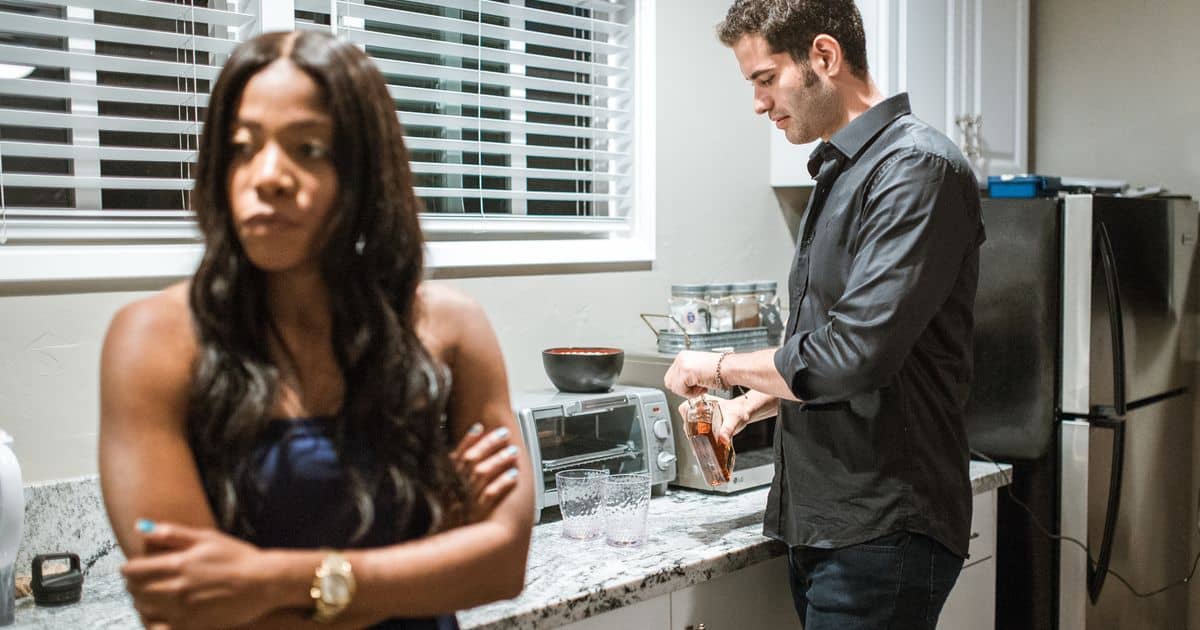
When your wife won’t discuss relationship issues, it is almost never because she does not care. Her body hears “can we talk about us” as a verdict on whether she is enough, so she freezes, goes flat, or says “nothing is wrong” to survive the shame. The harder you push, the further she retreats.
What to do tonight: drop the demand for a talk, tell her one true sentence about your own fear, like “I don’t need you to say anything, I just wanted you to know where I am,” and then sit near her without asking for anything.
Recognize yourself in this?
Talk to Figlet about your wife shutting down right now. AI relationship coaching grounded in Figs O’Sullivan’s work, LMFT. Free to start, no credit card.
You are standing in the kitchen. You said the thing you have been rehearsing for three days. Something like, “Can we talk about us.” And she looked at her phone, or the sink, or somewhere just past your left shoulder, and said she was tired. Or fine. Or that there was nothing to talk about. Or nothing at all.
Now you are on the couch at eleven at night, typing “wife won’t discuss” into a search bar, feeling a specific kind of lonely that only exists inside a marriage. Your chest is tight. There is a low hum of panic under your ribs. You are trying to figure out if she has stopped loving you, if you are being stonewalled, if you should push harder, if you should give up.
I want to slow you down before you scroll another listicle.
I have been a couples therapist for seventeen years. I have watched this exact dynamic thousands of times, from every angle, in every kind of marriage. And I need to tell you something that almost no article on this topic will say plainly: your wife is not refusing to discuss the relationship because she does not care. She is refusing because, somewhere in her body, she cares so much that the possibility of failing you has become unsurvivable.
If that sentence lands, keep reading. The rest of this piece is built on it.
What the Internet Gets Wrong About a Wife Who Won’t Talk

Which pattern is running your relationship?
Take the free three minute quiz and meet the creature behind the cycle you keep getting stuck in.
The dominant script online for a wife who won’t discuss relationship issues goes roughly like this: schedule a weekly meeting, use “I feel” statements, create a safe space, ask open-ended questions, try again when she is relaxed.
I want to be careful here. That advice is not exactly wrong. It is aimed at the wrong problem.
What I actually watch happen in my office goes like this. A husband, prepared and reasonable, sits down and says, “Honey, I just want us to talk about what has been going on between us.” He believes he is making a request for connection. His body language says calm. His voice says curious. He is doing everything the articles told him to do.
And her body, in the same second, does not process a request. It processes a verdict.
The internal translation, and I have heard this said out loud by hundreds of withdrawing wives once the armor comes down, goes something like: I have failed you before. I am failing you now. And this conversation is going to be one more piece of evidence that I will keep failing you into the future.
If her silence has spread from the hard topics to almost everything, I wrote about when your wife won’t talk to you for weeks.
Grounded in attachment theory, adult love partners regulate each other the way a caregiver regulates an infant. When the bond wobbles, the amygdala hits the alarm before the thinking brain has a chance to speak. Cortisol dumps. Reason exits. Both of you catch fire in the same moment.
What looks like her refusal to discuss anything is a survival response, not a character flaw. Trying to solve it with a better opening line is like trying to talk someone out of a panic attack with a slide deck.
From Empathi’s own research: in 58,221 completed relationship assessments, 74.1% of the 6,159 couples where both partners completed were in the pursue-withdraw cycle. Both partners typically describe the other as the one withdrawing.
The Two Questions Running Under Every “Can We Talk”
I tell every couple I work with that the bonded body is only ever asking two questions, and never in words.
Are you there for me?
Am I enough for you?
You are probably feeling the first one louder. Your wife is probably feeling the second one louder. And here is the piece almost nobody names: you are both answering the same threat with opposite moves.
When you feel the distance in your marriage, you reach. You want more talking, more contact, more clarity. The gap between you feels like the first inch of losing her, so you close it with words.
When she feels the distance, she retreats. Not because closeness is unwanted. Because she cannot stand the possibility that she is the reason you are in pain. The question underneath every conversation arrives with the answer already glued to the back of it: Am I enough for him. No, apparently not, or we would not be having this conversation.
Your reaching, in her body, sounds like a slow indictment. Every carefully worded “I feel” statement gets translated into “here is one more way you have let me down.” Not because you meant it that way. Because her nervous system, shame-sensitive and already braced, cannot hear it any other way.
So she goes quiet. And your quiet wife looks, to your terrified reaching self, like a woman who has stopped caring.
Neither of those readings is accurate. You are both scared. You are both alone. You are running the same panic in opposite directions.
What Silence Is Actually Doing Inside Her
Let me try to describe what I watch happen inside a wife who won’t talk, because it will change what you do next.
Her chest goes cold. Her throat closes. There is a heaviness in her shoulders that she cannot explain to you because she cannot explain it to herself. When you bring up “us,” her somatic ledger, the body’s running record of safety and threat, registers your feedback as a capability failure. Not “my husband wants to connect.” More like “I am about to be told, in some soft, therapeutic voice, that I am failing at the most important job I have.”
To survive that flood, she contracts. She goes flat. She becomes reasonable, or busy, or asleep, or gone.
In my clinical work, I sometimes call this her Silent Protector. It is the polished version of herself she deploys because her organic, wobbly, frightened self feels unlovable in this moment. She is not withholding out of malice. She is disappearing behind a competent mask because the raw self underneath believes it will get her rejected.
If you want the fuller picture of what is happening biologically when this happens, I’ve written more about it in why does my partner ignore me. The short version: her nervous system is not ramping up like yours. It is collapsing down. From the outside it looks like coldness. From the inside, it feels like drowning.
The Waltz of Pain: How Two Decent People Build This Loop
Every couple stuck in this pattern is dancing some version of the same choreography. In my practice I call it the Waltz of Pain. Not because it is dramatic, but because it is circular, patterned, and neither of you can stop it by trying harder inside your existing role.
The dance goes like this. Something wobbles the bond. A missed evening. A phone at dinner. A weekend where you barely touched each other. Your body sounds an alarm. You reach, verbally, for repair. Her body reads that reach as another verdict on her adequacy. She retreats to survive the shame. Her retreat sounds, to your alarm system, like abandonment. So you reach harder. Which she reads as more pressure. Which she survives by going further away.
Around and around. Neither of you is the villain. The loop itself is the enemy.
And here is the piece that undoes most husbands sitting where you are sitting: the harder you pull on the content of the conversation, the tighter the trap gets. You cannot argue her into talking. You cannot logic her out of a freeze response. Every additional attempt to explain why she should be willing to discuss things confirms, for her body, that she is about to be walked through her own failures again.
If your version of this has been going on for months or years, why talking about your relationship keeps making it worse is worth your evening.
What To Actually Do: Stop Working the Content, Start Working the Ground
So what do you do when your wife won’t discuss relationship issues?
You stop trying to have the conversation. You start trying to build the conditions under which a conversation becomes biologically possible.
That is not a therapy trick. It is the whole clinical shift.
Concretely, it looks like this.
1. Turn the flashlight off her and back onto yourself.
Most husbands sitting where you are sitting have built what I call a Story of Other. It is the case you have been running against her in your head. She never wants to talk. She shuts down every time. She is being cold. She does not care.
That case might contain real observations. But every minute you spend prosecuting it is a minute you are not looking at what is happening inside your own chest.
Turn the flashlight the other way. What is actually in your body right now. Not the argument. The sensation. A tightness. A cold spike. A low panic. Underneath the tightness, if you can stay with it, is almost always a much younger fear: I am going to lose her. I already have. I don’t matter to her.
That is not weakness. That is your attachment system doing exactly what it was designed to do. But if you can locate it in yourself before you approach her, you approach her as a scared man asking for contact, not as a prosecutor asking for a plea.
Two different bodies walk into the room. She will feel the difference before you say a word.
2. Name what you are, not what she is not.
The moment you say, “You never want to talk about our marriage,” her Silent Protector snaps online and the room goes cold.
Try, instead, something closer to: “I have been scared for a while. I don’t know how to say it without it sounding like I am blaming you. I feel far away from you and I don’t know what to do with that.”
You are not asking her to fix anything. You are not making a request. You are letting her see the wobbly, frightened part of you that has been hiding behind the case you have been building.
Her body cannot process the second one as a verdict. There is no verdict in it. There is a scared human. Her nervous system may not know what to do with that at first. That’s fine. You have just changed the dance step.
3. Take pressure off the outcome.
If you approach her with “I need us to talk” or “I need you to open up,” you have loaded the moment with a demand her body cannot meet without failing. She hears the ask. She hears her almost-certain failure to satisfy it. She braces or disappears.
Take the demand off. “I don’t need you to say anything. I just wanted you to know where I am.” That sentence sounds like nothing. Clinically, it is enormous. You have removed the trap.
Ready to work on this?
Figlet is AI relationship coaching grounded in attachment science and Figs O’Sullivan’s clinical work, LMFT. First messages free, no signup.
4. Slow down. Way down.
The instinct, when your wife won’t talk, is to fill the silence. More words. More explanation. More trying to help her see. Every additional word raises the temperature in her body.
A withdrawing nervous system needs quiet, not more input. It needs a partner who can sit near it without demanding it produce anything. If you can be in the same room without talking, without checking your phone, without pointedly waiting for her to break, you are doing more repair work than any conversation would accomplish.
Sometimes I tell husbands: sit on the couch with her, one hand touching her foot, and watch something dumb on television. That is the work. You are teaching both nervous systems that being near each other does not have to mean being interrogated.
5. Attend to your own regulation first.
You cannot coax a scared animal out of hiding while you are still on fire. If your body is running the alarm, she will feel it, no matter how carefully you word your opening line. Walk. Cold water on your face. Breathe until your shoulders drop half an inch. Text a friend. Move the panic somewhere before you bring the rest of it to her.
This is what a lot of the writing on attachment styles in relationships is pointing at when it talks about self-regulation. It is not about becoming an island. It is about not showing up to your wife with a fire in your hand and expecting her to walk into it.
When Face to Face Keeps Failing
Ask one honest question first: is she silent about everything, or about one topic? If she can laugh with you about the kids but freezes the moment money, sex, or “us” comes up, that topic has become the place where she most expects to be found lacking. Come at it slowly. If the silence has spread to almost everything, the bond itself is in alarm, and the steps above matter more than any conversation.
Watch your timing. Eleven at night, mid fight, or as she walks in the door is when her body is least able to hear anything that sounds like feedback. Pick a calm, private moment.
Try a different channel. Some withdrawing partners can read what they cannot hear. A short note written from your own fear, not your case against her, lets her take it in without being watched. No list of grievances. End with something like, “You don’t have to answer this. I just didn’t want to keep carrying it alone.”
Get support for yourself. If she will not come to couples therapy, go anyway. One partner changing their steps changes the dance. I have watched the pursuing partner stop prosecuting, and within weeks the withdrawing partner starts to edge back toward the middle of the room.
Know the one exception. All of this assumes a frightened partner, not a dangerous one. If you are afraid of her, or the silence comes with threats or control, get outside help right away.
What This Is Actually Building Toward
If you do this well, and by well I mean imperfectly and repeatedly, something starts to shift.
Not fast. This is not a hack. It is proof of work.
Her Silent Protector will start to loosen because you are no longer confirming, over and over, that she is about to be tried for capability failure. Her body will begin to register you as someone who can be near her without needing her to be different than she is. In tiny moments, a real conversation will surface. Usually not the one you were planning. Something smaller. A sentence about her day. A hand on your arm. A moment of eye contact that lasts a beat longer than usual.
Those are the returns on the work. Not a state-of-the-union talk. Contact.
Over time, if both of you can stay in this, you begin building what I sometimes call the couple bubble. Two nervous systems that trust the ground between them enough to bring the hard stuff into it. That is what secure functioning actually looks like on a Tuesday night. Not the absence of conflict. The presence of a bond that can hold conflict when it comes.
This is not a you problem or a them problem
“Relationship distress is a feature, not a bug, of loving someone so much that their emotional distance feels terrifying. It is the predictable dance of two nervous systems desperately trying to survive the perceived loss of one another.”
“The fight is never about the content. It is always about the bond.”
Figs O’Sullivan, LMFT
Common Questions
What do you do when your wife refuses to talk about problems?
Stop trying to have the conversation and start building the conditions that make one possible. Regulate your own body first, tell her one true sentence about your fear instead of a complaint about her, and stay near her without asking for anything. A withdrawing nervous system opens to safety, not to pressure.
Is it normal for a wife not to like being asked questions?
Very common, especially in a marriage stuck in the pursue and withdraw loop. To a shame-sensitive partner, a run of questions about the relationship can feel like an interrogation, each one another chance to be found lacking. Ask fewer questions, share more of what is happening in you, and let her come toward the conversation at her own pace.
Why is my wife always angry but never wants to talk about it?
Anger is rarely the primary emotion. Underneath it is usually a protest about feeling unseen, alone, or not a priority. When she flares and then refuses to discuss it, she is often caught between protest and shutdown. Respond to the hurt under the anger, not the volume, and wait until both of you are calm before you name what happened.
Why does my wife say “nothing is wrong” when everything is clearly wrong?
She is not lying to you. In that moment, her body has gone into shutdown, which is a protective freeze response. When the nervous system collapses like that, actual access to what is wrong goes offline. “Nothing” is not a strategy. It is often the honest report from a system that has flattened itself to survive the shame of feeling like a failure. Give it time and space, not more questions.
Should I give my wife an ultimatum to go to couples therapy?
Ultimatums almost always backfire with a withdrawing partner. Her body reads the ultimatum as one more piece of evidence that she is about to be judged and found lacking, and she braces harder. What tends to work better is asking her to come support you while you work on yourself, or framing therapy as a place for both of you to be met, not a courtroom where she will be sentenced. Persistence yes, pressure no.
How long does it take for a shutdown wife to open up again?
There is no honest number. What I can tell you clinically is that when the pursuing partner genuinely stops prosecuting and starts self-regulating, most withdrawing partners begin to soften within weeks, not months. Not into a big talk. Into small returns of contact. A joke. A touch. Sustained change takes longer, and usually needs some outside support to hold the new pattern in place.
Is my wife emotionally abusive because she refuses to talk?
Almost certainly not. Stonewalling as a survival collapse is not the same thing as coercive control. Abuse is a pattern of contempt, cruelty, or control that leaves you smaller. Withdrawal is a pattern of protection that leaves you both lonely. If you are unsure which one is happening, the tell is usually how she treats you when the alarm is off. If there is warmth, humor, and care in the good moments, you are dealing with a dynamic, not an abuser.
What if I have been the withdrawing one and now she has given up on talking?
This is more common than most men admit. If your wife stopped bringing things up because you shut every conversation down for years, her silence now is not the same as her silence at the start. She is grieving. The work here is longer and slower. It starts with you naming, without defense, that you understand why she stopped reaching, and that you are willing to do the work of becoming someone she can risk reaching for again. That is a real conversation, and it may need a therapist in the room to hold it.
Do not just close the tab on this.
Bring what surfaced here into a real conversation. Figlet coaches you through it, grounded in Figs O’Sullivan’s work, LMFT. Free to start.
Your wife is not the wall. The wall is what her body built to survive a conversation she was sure she was going to lose. Stop pushing on the wall. Sit next to it. Let her feel you there, not asking anything, not proving anything, just present. That is where the door is.
Keep Reading



Every couple has a pattern they cannot see. Find yours.
In love, each of you is a Relentless or a Reluctant, which makes you one of three kinds of couple: Relentless and Reluctant, two Relentless, or two Reluctant. The free quiz reveals your creatures and the cycle they fall into together. About three minutes.
No signup needed to start.
The Relentless

The Reluctant